


Before You Heat It: THCA Side Effects Buyers Should Know About COAs
Unheated THCA itself carries minimal documented side effects because human safety data on the raw compound remains limited. The real risk shows up the moment heat enters the picture: smoking, vaping, or baking converts THCA into delta-9 THC, triggering the dry mouth, rapid heartbeat, and coordination issues associated with THC, and producing a metabolite that standard workplace drug tests detect. Treat any heated THCA product exactly like THC for safety and employment purposes.
TL;DR:
- Heat converts THCA into THC almost instantly when smoked or vaped, creating typical THC side effects and drug-test detection risks.
- Raw, unheated THCA is considered non-intoxicating, but residual conversion from processing or storage heat can still produce psychoactive effects.
- The legal and potency implications depend on total THC content, including both THCA and delta-9 THC, which must be measured and verified by lab testing.
- Side effects such as dry mouth, increased heart rate, and impaired coordination are well documented after THC conversion, but evidence for THCA-specific effects remains limited.
- Reducing risk involves checking certificates of analysis, starting with low doses, avoiding use during pregnancy or safety-sensitive activities, and consulting clinicians if on medications.
Table of Contents
- What Is THCA and How Does It Differ From THC?
- What Are the Common and Rare THCA Side Effects?
- What Factors Change Your Risk of Side Effects?
- How Does Heating Turn THCA Into Psychoactive THC?
- How Can You Reduce THCA Side-Effect Risk?
- What Should You Do If Side Effects Happen?
- Why Author Credibility and Lab Testing Matter Here
- Raw THCA vs. Processed Products: Does the Delivery Method Change the Risk?
- A Publisher’s Honest Take on THCA Safety Claims
- Explore Lab-Tested THCA Products From Hemp-flower
- Sources
- FAQ
What Is THCA and How Does It Differ From THC?
THCA, or tetrahydrocannabinolic acid, is the raw acidic compound that raw cannabis and hemp plants produce naturally. It is not the same molecule as delta-9 THC, the compound responsible for cannabis intoxication. THCA only becomes THC through decarboxylation, a chemical reaction triggered by heat that strips away a carboxyl group and leaves behind the psychoactive form.
Smoking or vaping accomplishes this conversion almost instantly. Baking THCA into an edible does the same thing more slowly, but the end result is chemically identical: active THC circulating in the body.
Here’s where the science gets thin. Controlled human trials on isolated THCA are rare, and most claims about its effects come from preclinical work or small observational reports rather than the kind of large clinical trials that back up what we know about THC. That evidence gap matters for anyone comparing “THCA health risks” against the well-documented THC side-effect profile.
A few things worth understanding before going further:
- THCA in its raw, unheated state is generally considered non-intoxicating.
- Decarboxylation converts THCA to THC through heat exposure, not through digestion or time alone.
- Lab reports distinguish “total THC” (THCA plus delta-9 THC, adjusted for conversion) from “delta-9 THC only,” and the difference changes how a product’s legal status and potency get read.
- Human clinical safety data specific to THCA remains sparse, which is why the endocannabinoid system overview from Harvard Health frames cannabinoid research broadly rather than compound by compound.
What Are the Common and Rare THCA Side Effects?
Side effects of THCA split cleanly into two buckets: what happens after the compound converts to THC, and what gets reported, less reliably, from raw THCA itself. Confusing the two is where a lot of misinformation starts.
Common short-term effects (after conversion to THC):
- Dry mouth, sometimes called “cotton mouth,” from reduced saliva production.
- Elevated heart rate (tachycardia), which can feel alarming in higher doses.
- Bloodshot or red eyes from changes in blood vessel dilation.
- Impaired coordination and slower reaction time.
- Short-term memory lapses during the intoxication window.
- Mild to moderate anxiety, particularly in people who are cannabis-inexperienced.
These effects are well documented in cannabinoid pharmacology literature covering THC exposure generally, and they scale with dose. A single puff produces a different experience than a concentrated dab.
Quick Stat: Standard workplace urine screening uses a 50 ng/mL cutoff for initial immunoassay tests, with confirmatory testing set at 15 ng/mL for the THC metabolite THC-COOH. Both thresholds catch THC that originated from heated THCA just as reliably as THC from any other source.
Effects sometimes attributed to raw THCA: A handful of small studies and case reports mention drowsiness or reduced appetite tied to THCA preparations, but the sample sizes are small and results are mixed. Some reports describe the opposite effect. This is not settled science, and anyone reading a confident claim about “THCA-specific” side effects should treat it skeptically.
Rare but serious reactions deserve direct attention because they get glossed over in casual product marketing:
- Severe anxiety or panic attacks, more common at high doses or in first-time users.
- Cannabis-induced psychosis symptoms, which are rare but documented in vulnerable individuals.
- Allergic reactions, including skin irritation or, in rare cases, respiratory symptoms.
- Respiratory irritation from smoking any plant material, independent of the cannabinoid content.
Potential long-term concerns center almost entirely on repeated heavy use rather than occasional consumption. Cannabis use disorder, a form of dependence, is a recognized risk with frequent high-dose use. Cognitive effects with chronic heavy use, particularly in adolescents, show up in the research literature, though the evidence strength varies by study design and population. None of this is unique to THCA. It’s the same profile that applies to any THC-containing product, because that’s what heated THCA becomes.
What Factors Change Your Risk of Side Effects?
Not every THCA product behaves the same way in the body, and not every person reacts the same way to it. A few variables do most of the work in determining whether someone experiences mild effects or something more uncomfortable, including the influence of cannabis terpenes as explained in this cannabis terpenes guide.
- Dose and frequency. Higher amounts and repeated use compound both intensity and detection window length.
- Route of administration. Smoking and vaping deliver near-instant conversion and rapid onset; edibles convert more slowly through cooking and digestion, delaying effects but not necessarily reducing them.
- Product quality. Mislabeled delta-9 content, unexpectedly high THCA percentages, or contamination from pesticides and solvents can all push side effects beyond what a label suggests.
- Individual factors. Body fat percentage, metabolism, pregnancy, and current medications all shift how THC-derived compounds get processed.
Pro Tip: Always request the certificate of analysis (COA) for any THCA product before buying, and check that it lists “total THC,” not just delta-9 THC. A raw THCA percentage that looks compliant on paper can still convert into a meaningful THC dose once heated.
Medication interactions deserve a mention here too. THC and its metabolites can interact with blood thinners, sedatives, and certain psychiatric medications, so anyone on a regular prescription regimen should flag cannabis use, including hemp-derived THCA products, with their prescribing clinician.
How Does Heating Turn THCA Into Psychoactive THC?
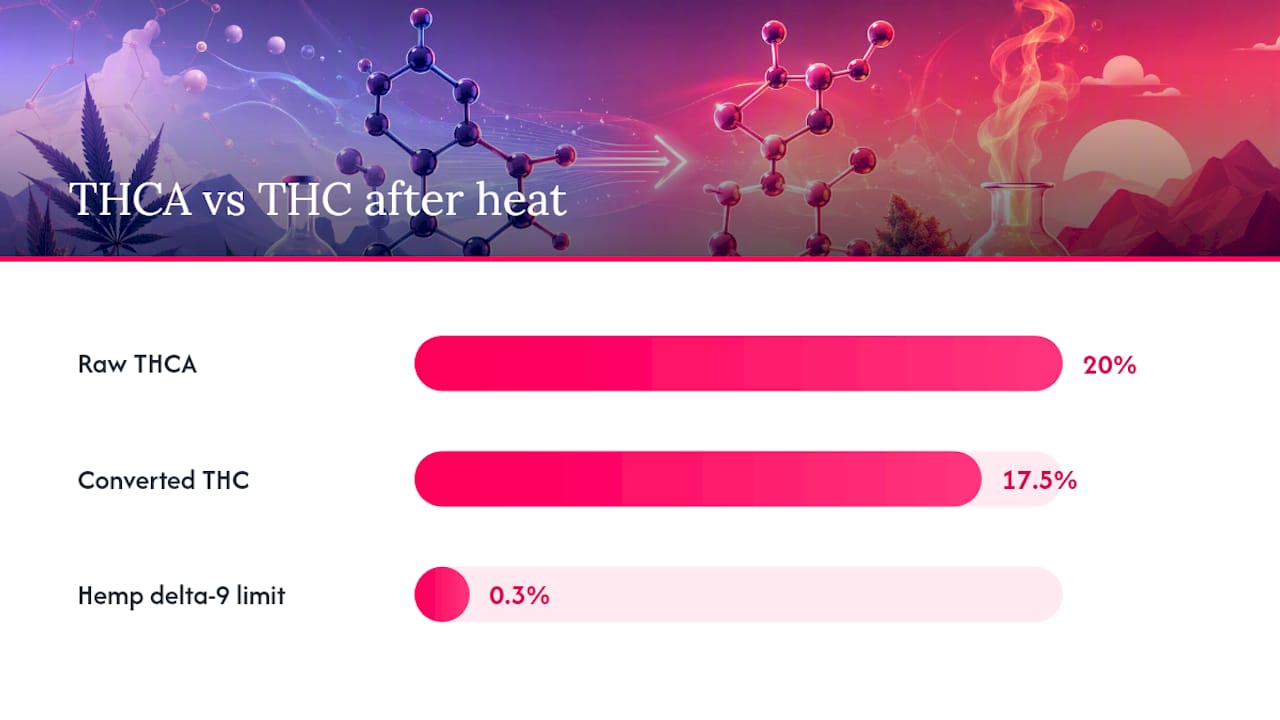
Decarboxylation is the chemical process that removes a carboxyl group from THCA, converting it into delta-9 THC. Heat is the trigger, and the speed depends on how that heat gets applied. Smoking or vaping converts THCA into THC in seconds, essentially instantly, because combustion temperatures exceed what the reaction needs by a wide margin. Baking or cooking THCA into food achieves the same conversion over minutes rather than seconds, which is why recipes calling for cannabis flower usually include a decarboxylation step in the oven.
Labs account for this chemistry with a conversion math problem: THCA loses mass as it sheds a carboxyl group in the form of carbon dioxide, so one milligram of THCA does not produce one milligram of THC.
- Labs apply a conversion factor of approximately 0.877 to calculate how much THC a given amount of THCA will yield once decarboxylated.
- This is why lab reports list “total THC” as a separate figure from raw delta-9 THC content.
- Under the 2018 Farm Bill, hemp must test at or below 0.3% delta-9 THC on a dry-weight basis, but total THC calculations factor in the THCA that would convert upon heating.
Quick Stat: A flower testing at 20% THCA and near-zero delta-9 THC can still deliver roughly 17.5% THC by weight once smoked or vaped, using that 0.877 conversion factor. The legal compliance number and the practical psychoactive number are not the same thing.
Smoking or vaping THCA flower is, functionally, a THC delivery method. Anyone who assumes a product is “non-psychoactive” because its raw lab panel shows low delta-9 THC is working from the wrong number.
How Can You Reduce THCA Side-Effect Risk?
Reducing risk starts with treating THCA products the way you would treat any THC product, because heating erases most of the distinction. A few concrete habits make the difference between a manageable experience and an unpleasant one.
- Read the full COA, not just the headline number. Look specifically for “total THC,” pesticide screening, heavy metals, and residual solvents. A product without a current COA is not one worth trusting.
- Start low and wait before redosing. With smoking or vaping, effects onset within minutes, so waiting 15 to 20 minutes before deciding whether to take more is reasonable. With edibles, onset can take 45 minutes to two hours, and redosing too soon is one of the most common causes of overwhelming reactions.
- Choose your method based on your actual goal. Raw, unheated THCA products, like tinctures held under the tongue without heat activation, carry a lower intoxication risk, but residual conversion from prior processing or storage heat can still leave measurable THC content. Nothing labeled THCA is guaranteed non-psychoactive.
- Avoid use during pregnancy or breastfeeding. THC crosses the placenta and appears in breast milk, and no safety threshold has been established for either context.
- Skip it before safety-sensitive work. Operating vehicles or machinery under any THC influence, intentional or from a converted THCA product, carries the same impairment risk.
- Talk to a clinician if you take blood thinners, sedatives, SSRIs, or other psychiatric medications. Cannabinoids can alter how the liver metabolizes several common drug classes.
Pro Tip: If you’re comparing raw flower against a THCA vape cartridge or dab wax, remember that concentrates convert just as completely as flower does. Higher potency concentrates simply mean a bigger THC dose delivered faster, not a fundamentally different risk category.
What Should You Do If Side Effects Happen?
Most THCA-related side effects resolve on their own within a few hours, and the right response is usually patience rather than panic.
- For mild reactions (dry mouth, mild dizziness, fatigue): hydrate, sit or lie down, and avoid taking more product. Symptoms typically ease as the THC metabolizes.
- For anxiety or panic symptoms: slow, deliberate breathing and grounding techniques, focusing on a physical object or counting backward, can shorten the episode. Moving to a calm, familiar space helps more than trying to push through it in a crowd.
- Seek emergency care for chest pain, difficulty breathing, a racing heart that doesn’t settle, or psychotic symptoms like severe confusion or hallucinations that don’t resolve.
- Bring documentation. If you seek medical attention, having the product’s COA and packaging on hand gives a clinician real information to work with, rather than guesswork about what was actually consumed.
Why Author Credibility and Lab Testing Matter Here
Claims about THCA safety are only as good as the evidence and testing standards behind them… That grounding matters more in this category than most, given how thin the controlled human research on raw THCA still is.
For readers who want more on the practical experience side, our breakdown of THCA flower effects and how long they last covers onset timing in more detail, and the explainer on THCA versus delta-9 THC walks through the legal distinctions that COAs are built around.
- Hemp Flower Co. emphasizes lab testing and transparent sourcing across its product lineup, consistent with the total-THC reporting standards discussed above.
-.
- Readers should still independently verify any COA before purchase, regardless of the source.
Raw THCA vs. Processed Products: Does the Delivery Method Change the Risk?
Raw THCA, consumed without heat, in something like a properly formulated tincture, theoretically avoids the intoxication that comes with smoking or vaping. In practice, the distinction is less clean than marketing copy suggests.
Tinctures and capsules marketed as “raw THCA” often undergo some processing heat during extraction or stabilization, meaning at least partial conversion to THC has already happened before the product reaches a bottle. A tincture that lists both THCA and delta-9 THC on its COA has already crossed that line to some degree; one listing only THCA and testing near-zero on delta-9 THC is closer to the non-intoxicating category the marketing implies.
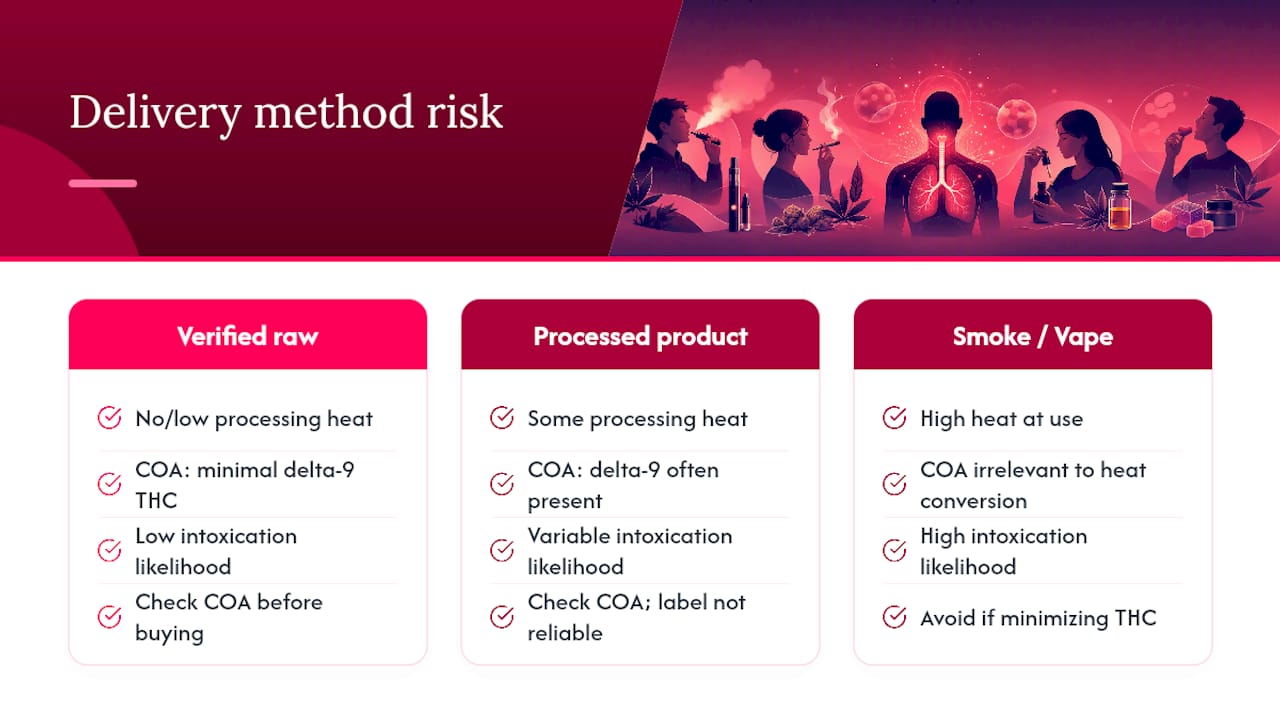
Capsules face a similar issue, compounded by the fact that gelatin or plant-based capsule shells sometimes involve low-heat manufacturing steps. The safest assumption for any processed product is to check the COA rather than trust the label copy, because “raw” is a marketing term, not a regulated one.
Smoked or vaped flower, and concentrates like wax or crumble, skip the ambiguity entirely. Heat is guaranteed, conversion is near-total, and the side-effect profile is the established THC profile discussed earlier. If minimizing THC exposure is the actual goal, a verified-raw tincture or capsule with a COA confirming minimal delta-9 THC content is the more predictable choice, not smoked flower assumed to be “different because it says THCA on the jar.”
A Publisher’s Honest Take on THCA Safety Claims
The interest in THCA benefits is understandable. It’s an active area of preclinical research, and the plant compound story is genuinely interesting. But the human safety data isn’t there yet, and no amount of enthusiasm changes that gap. Heating turns THCA into THC, full stop, and that means drug-test risk, workplace consequences, and the standard THC side-effect profile all apply the moment a lighter or vaporizer gets involved. Check the COA, ask a clinician if you take other medications, and don’t assume “THCA” on a label means something fundamentally different is happening in your body once you light it up.
— Michael
Explore Lab-Tested THCA Products From Hemp-flower
Hemp-flower’s advantage isn’t a marketing claim, it’s a paper trail: every product ships with lab testing and transparent sourcing so you can see total THC, not just a headline percentage, before you buy.
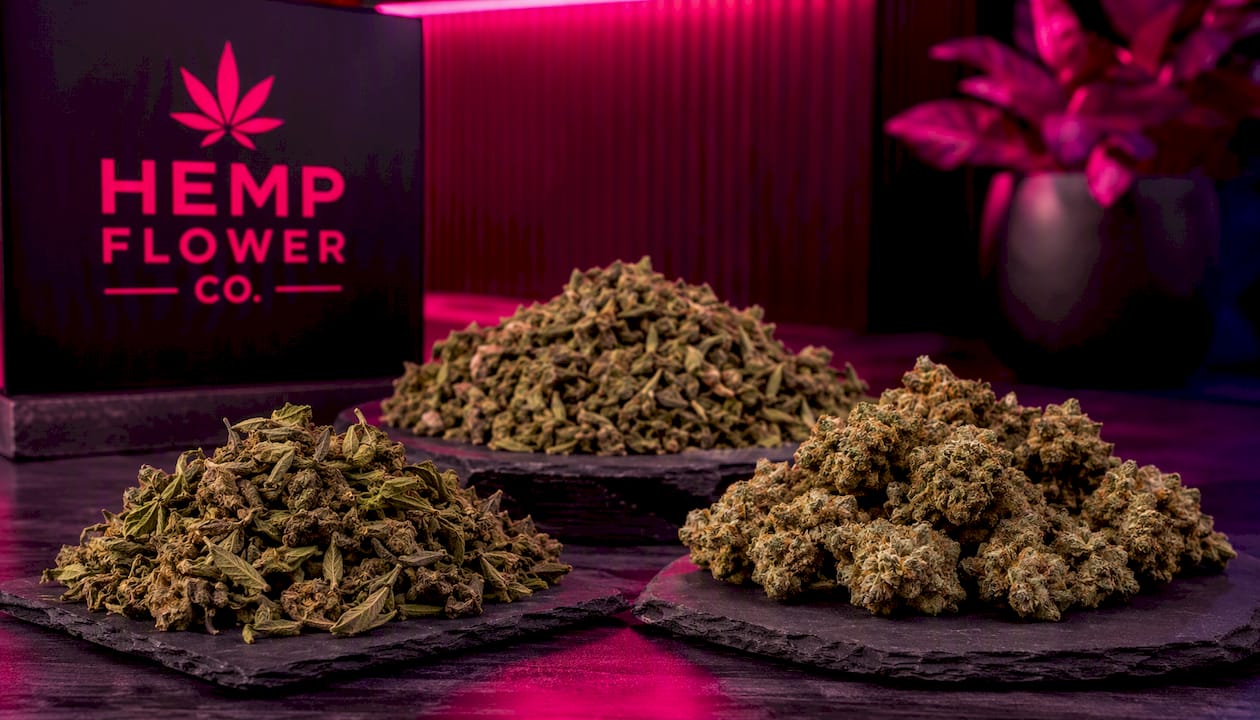
That matters more in this category than most, given how much confusion surrounds raw versus converted THCA. The indoor and greenhouse THCA flower lineup covers a range of strains for people who want flower with verified COAs on file, while the concentrates collection, including THCA budder and crumble wax, suits anyone comparing potency and conversion math discussed above. If vaping or pre-rolls fit your routine better, the vape and pre-roll selections offer lower-commitment entry points. Wholesale buyers and dispensaries can review the Turtle Taffy Full-Term THCa Trim, Face Fat Full-Term THCa Trim, and TriCross THCa Flower Smalls listings for bulk pricing and COA access. Before ordering anything, pull the certificate of analysis and, if you take regular medications, consult a clinician first.
This article is general information, not a substitute for advice from a qualified doctor. Consult a qualified healthcare professional about your own circumstances before acting on anything here.
Sources
- PMCID: PMC8669157
- Pharmacological actions and associated therapeutic levels of phytocannabinoids (addendum)
- The endocannabinoid system — Harvard Health Blog
FAQ
Does THCA Cause Anxiety Like THC Does?
Raw, unheated THCA has not been shown to cause anxiety in the way THC does, largely because it isn’t intoxicating in its acidic form. Once heated and converted to THC, though, anxiety and paranoia are recognized dose-dependent effects, especially at higher doses.
Will THCA Show Up on a Drug Test?
Yes, if it has been heated. Smoking, vaping, or cooking THCA converts it into THC, which metabolizes into THC-COOH, the exact compound standard workplace urine tests screen for at a 50 ng/mL initial cutoff.
How Long Does THCA Stay in Your System After Use?
Once converted to THC, detection windows follow standard THC timelines, which can range from a few days for occasional use to several weeks for frequent, heavy use, depending on metabolism and body fat. There’s no separate “THCA-only” detection window once conversion has occurred.
Is THCA Safe to Use Regularly?
Human safety data on raw, unconverted THCA is too limited to make a firm safety claim either way, so caution is warranted. Once heated, it carries the same risk profile as regular THC use, including dependence risk with heavy, frequent consumption.
What’s the Difference Between THCA Flower and THCA Concentrates in Terms of Side Effects?
Both convert to THC when heated, so the side-effect profile is the same in kind, but concentrates like wax or crumble typically deliver higher THC potency per dose. That makes overconsumption easier with concentrates, which is why starting with a smaller amount matters more with dabs than with flower.


