


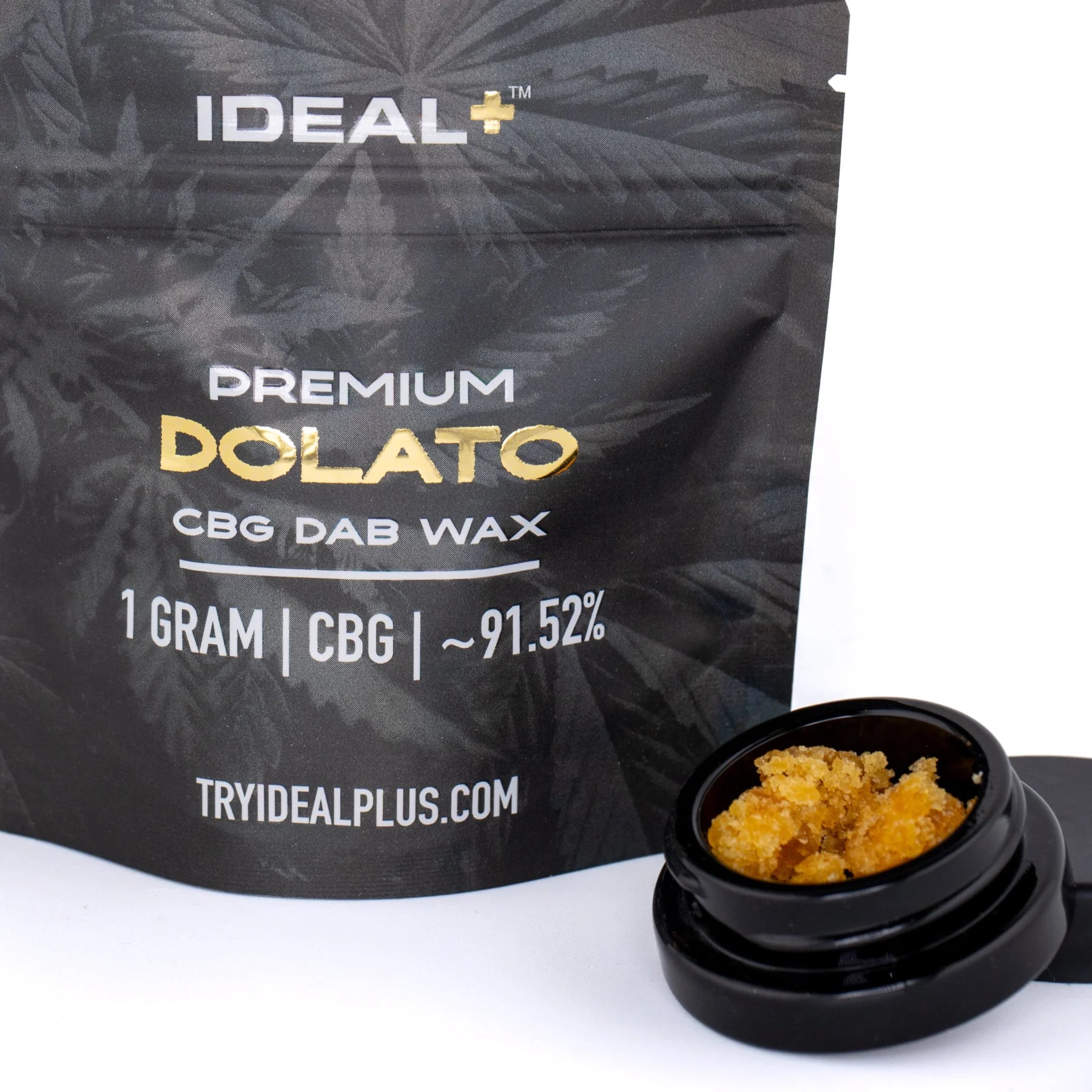




Dolato 91.52% CBG Dab Wax 1g
Availability:
Out Of Stock
- $19.99
- $19.99
- Unit price
- per
Subtotal:
$19.99

Dolato 91.52% CBG Dab Wax 1g by Ideal Plus
Key Features and Strain Information
- Hemp Strain: Dolato 91.52% CBG Dab Wax 1g by Ideal Plus
- Type: Indica-Dominant Hybrid (70% Indica / 30% Sativa)
- Total Cannabinoid Potency: 91.52%
- CBG Content: 86.42%
- Δ9-THC Content: 0.01% (Non-Intoxicating)
- Genetics: Gelato #41 × Dosido (NorCal Cut)
- Dominant Terpenes: α-Pinene, β-Pinene, Geraniol, Linalool, Limonene
- Aroma: Sweet and Earthy with Spicy Musky Overtone, Fresh Pine
- Flavor: Sweet Berry Pine with Light Spicy Exhale
- Effects: Calming, Euphoric, Relaxed, Cerebral Clarity
- Product: CBG Concentrate
- Form: Dab Wax
- Weight: 1 Gram
- Brand: Ideal Plus
- Purity: 100% Organic, No Pesticides, No Additives, No Synthetics
- Testing: Lab Tested for Purity and Compliance
- Legal Compliance: Federal Farm Bill Compliant
Detailed Cannabinoid Profile
- CBG: 86.42%
- CBDa: 2.12%
- CBD: 0.98%
- CBC: 1.94%
- Δ9-THC: 0.01%
- Total: 91.52%
Introduction to Dolato CBG Dab Wax
Cannabigerol (CBG) has emerged as one of the most exciting cannabinoids in the hemp industry, earning the nickname "the mother of all cannabinoids" for its role as the precursor from which other cannabinoids develop. For consumers seeking the unique therapeutic potential of CBG in its most potent and efficient form, Dolato 91.52% CBG Dab Wax 1g by Ideal Plus represents the gold standard in premium CBG concentrates. This exceptional CBG wax delivers an extraordinarily high 86.42% CBG content alongside a supporting cast of beneficial cannabinoids, all derived from the celebrated Dolato strain genetics that have earned devoted followers across the cannabis world.
Dolato is an Indica-dominant hybrid strain (70% Indica / 30% Sativa) created through crossing the classic Gelato #41 with the NorCal cut of the infamous Dosido. This prestigious genetic lineage has produced a strain celebrated for its super relaxing effects that leave you kicking back without heavy sedation. The CBG-dominant version preserves the terpene profile, flavor characteristics, and general effect tendencies of the original Dolato while replacing the THC content with an exceptionally high concentration of CBG — offering unique therapeutic potential without any psychoactive effects.
Ideal Plus has established itself as a trusted source for premium CBG dabs by maintaining rigorous standards for quality, purity, and consistency. Every batch of Dolato CBG Dab Wax is produced from carefully cultivated hemp flower processed without pesticides, additives, or synthetics. The extraction process preserves the full spectrum of cannabinoids and terpenes that define Dolato's exceptional character, and every final product undergoes comprehensive lab testing to verify potency and purity. With a Δ9-THC content of just 0.01%, this CBG dab is fully Federal Farm Bill compliant, making it legal for purchase and use throughout the United States.
Understanding the Cannabinoid Profile
Understanding the complete cannabinoid breakdown is essential when purchasing CBG wax for sale or any cannabis concentrate. Dolato features one of the most impressive CBG-dominant cannabinoid profiles available in premium concentrates.
At 86.42% CBG, Dolato CBG Dab Wax delivers potency that far exceeds what CBG flower or most other CBG products can achieve. To put this in perspective, even high-CBG hemp flower typically contains only 10-20% CBG content. This concentrate delivers more than four times that potency, meaning exceptional efficiency and value for consumers who seek CBG's unique therapeutic potential. A single small dab of this dabs wax delivers CBG in quantities that would require significantly more flower material or numerous capsules to achieve through other consumption methods.
Why CBG is Called "The Mother Cannabinoid":
CBG (cannabigerol) holds a unique position in cannabis biochemistry. In the living plant, CBGa (cannabigerolic acid) serves as the precursor molecule from which THCa, CBDa, and CBCa are synthesized. This makes CBG the literal "parent" of the major cannabinoids. Because the plant naturally converts most CBGa into other cannabinoids, CBG is typically present in low concentrations in mature cannabis — making high-CBG concentrates like this CBG wax particularly valuable.
The supporting cannabinoids create a comprehensive profile that may enhance CBG's effectiveness through the entourage effect. CBDa at 2.12% and CBD at 0.98% offer their own potential therapeutic properties. CBC at 1.94% works synergistically with other cannabinoids and may contribute to mood regulation and comfort. This comprehensive cannabinoid ensemble ensures that Dolato delivers the full therapeutic potential of the hemp plant rather than isolated CBG alone.
The Δ9-THC content of 0.01% is virtually non-existent — well below the 0.3% Federal Farm Bill threshold and far too low to produce any intoxicating effects whatsoever. This makes Dolato CBG Dab Wax ideal for consumers who need or prefer to avoid THC entirely.
Genetics and Strain Heritage
The genetic foundation of Dolato CBG Dab Wax traces back to two of the most celebrated strains in modern cannabis breeding, creating an Indica-dominant hybrid with exceptional flavor and effect profiles.
Gelato #41 is one of the most famous phenotypes from the legendary Gelato line, itself a cross of Sunset Sherbet and Thin Mint Girl Scout Cookies. Gelato #41 (also known as "Bacio Gelato") has earned recognition for its exceptional flavor profile featuring sweet, dessert-like notes alongside its potent relaxing effects. The strain is known for producing dense, colorful buds with heavy trichome coverage. In the Dolato cross, Gelato #41 contributes the sweet, creamy flavor undertones and the euphoric, uplifting mental effects that balance the physical relaxation.
Dosido (NorCal Cut) is a powerful Indica-dominant hybrid created by crossing Girl Scout Cookies with Face Off OG. The NorCal cut specifically refers to a prized phenotype that circulated in Northern California, known for its exceptional potency and its deeply relaxing body effects. Dosido contributes earthy, pine-forward aromatics and the sedating physical relaxation that defines the Indica side of the Dolato experience.
When Gelato #41 meets Dosido, the result is Dolato — an Indica-dominant hybrid that balances cerebral euphoria with physical relaxation. The CBG-dominant hemp version preserves these genetic characteristics while replacing THC with high concentrations of CBG. For consumers shopping for CBG dabs online, the Dolato lineage represents one of the most flavorful and well-regarded genetic foundations available in CBG concentrate form.
What is CBG Dab Wax?
For consumers exploring CBG concentrates, understanding what CBG dab wax is provides essential context for making an informed purchase decision.
CBG dab wax is a cannabis concentrate rich in cannabigerol (CBG) designed specifically for vaporization through dabbing. The term "wax" refers to the concentrate's texture, which can range from soft and pliable to slightly firmer depending on processing methods. Unlike CBG oils designed for sublingual use or CBG edibles designed for digestion, CBG wax is formulated for inhalation through heated vaporization, providing the fastest onset of effects and the highest bioavailability of any consumption method.
How CBG Dab Wax Works:
When you heat CBG wax to vaporization temperature and inhale, the CBG and other cannabinoids enter your bloodstream through the lungs almost immediately. This rapid absorption means you can feel the effects within minutes rather than the 30-90 minutes required for edibles or the 15-30 minutes for sublingual oils. For consumers who need quick relief or prefer immediate results, CBG dab wax offers significant advantages over other CBG product formats.
Key Benefits of CBG Dab Wax:
Rapid onset is a primary advantage — effects begin within minutes of inhalation. High bioavailability means more of the CBG you consume actually reaches your system compared to oral consumption. Potency control allows precise dosing. The concentrate format preserves the full terpene profile, delivering flavor and potential aromatherapy benefits. And because CBG is non-intoxicating regardless of dose, you can enjoy the benefits without concern about impairment.
What Makes CBG Unique:
CBG interacts with the endocannabinoid system differently than CBD or THC. Research suggests CBG may bind to both CB1 and CB2 receptors, potentially offering a broader range of interactions. Early research has explored CBG's potential antibacterial, neuroprotective, appetite-stimulating, and anti-inflammatory properties. Many consumers find that wax CBG concentrates provide effects that feel distinct from CBD — often described as more energizing and focusing while still being calming.
Appearance and Texture
Dolato CBG Dab Wax presents with visual and textural characteristics that indicate premium quality and proper processing.
The color typically ranges from pale golden to light amber, reflecting proper extraction and the natural terpene content. CBG concentrates often present with a lighter coloration than CBD or THC concentrates, and this clean, attractive appearance indicates a product free from excessive plant material or contaminants. Quality cheap CBG wax should display this kind of appealing golden appearance that signals careful craftsmanship.
The texture is characteristically waxy — soft enough to work with easily but firm enough to maintain its shape and allow precise portioning. Dolato CBG Dab Wax yields readily to a dab tool, allowing you to scoop exactly the amount you need. This user-friendly consistency makes it accessible for both beginners and experienced concentrate enthusiasts.
The concentrate may show subtle crystalline formations — a normal indicator of high cannabinoid concentration. At 86.42% CBG, substantial crystalline structure within the wax matrix is expected and indicates a properly processed, high-potency product.
Aroma and Flavor Profile
Dolato CBG Dab Wax delivers the distinctive aromatic and flavor experience inherited from its celebrated parent strains, preserved beautifully in concentrated form.
The aroma is very sweet and earthy with a spicy musky overtone that's accented by fresh pine. This complex aromatic profile greets you immediately upon opening the container. The sweetness from the Gelato genetics provides an inviting entry point, while the earthy, piney notes from the Dosido lineage add depth and complexity. The spicy, musky character creates intrigue, making the overall aroma both pleasant and sophisticated.
This bud has a sweet berry pine flavor with a light spicy exhale that's slightly earthy. The inhale brings the berry sweetness forward — fruity and pleasant with hints of the dessert-like character that made the Gelato family famous. Pine notes emerge mid-palate, adding freshness and natural character. On the exhale, a light spicy earthiness grounds the sweetness, creating a well-rounded flavor arc that lingers pleasantly.
The dominant terpenes — α-Pinene, β-Pinene, Geraniol, Linalool, and Limonene — work together to create this exceptional profile. The dual Pinene presence provides the fresh pine character and potential focus-enhancing properties. Geraniol adds floral sweetness. Linalool contributes calming qualities and subtle lavender notes. Limonene provides citrusy brightness and mood elevation. For consumers who prioritize taste when shopping for cheap CBG dabs, Dolato offers a distinctly pleasant and complex flavor experience.
Effects and Experience
Dolato CBG Dab Wax delivers a distinctive experience characterized by calm clarity, gentle euphoria, and physical relaxation — without any intoxication or impairment. The effects are shaped by the high CBG content and the Indica-dominant genetics.
Calming Without Intoxication: The Dolato high is super calming in nature, with effects that leave you dazed and peaceful for hours and hours on end — but importantly, without the psychoactive "high" associated with THC. CBG works through different mechanisms than THC, providing relaxation without altering your mental state in an impairing way. You remain completely clear-headed and functional.
Cerebral Relaxation: The high starts with a lifted effect that fills your mind with deep cerebral relaxation. Unlike the foggy mental state some sedating products can produce, CBG's cerebral effects tend toward clarity and peace. Racing thoughts quiet, mental tension dissolves, and a sense of calm focus settles in. Many users of CBG dabs for sale report that CBG provides mental relaxation that actually enhances focus rather than diminishing it.
Physical Comfort: The warming tendrils of relaxation spread throughout the rest of your body, releasing tension and promoting physical ease. You'll feel euphoric and totally at ease, without any mental or physical aches or pains to speak of. The Indica-dominant genetics express themselves through this body-focused comfort, though without the heavy sedation or couch-lock that THC-dominant Indicas might produce.
Functional Relaxation: If you're after a super relaxing experience that will leave you kicking back without heavy sedation, you've found it. The CBG-dominant nature keeps the experience functional — you can enjoy the calming benefits while remaining capable of activity, conversation, or work if needed.
Therapeutic Applications: Thanks to these effects and its high 91% average CBG level, Dolato CBG Dab Wax is said to be perfect for treating conditions such as chronic pain, depression, insomnia, chronic fatigue, and muscle spasms or cramps. CBG research is still emerging, but early studies have explored potential antibacterial, anti-inflammatory, neuroprotective, and appetite-stimulating properties. The non-intoxicating nature makes it suitable for use at any time of day.
Dosing Considerations: Because CBG does not produce intoxication, dosing is more flexible than with THC products. Starting with a small amount allows you to find your optimal dose. The 1 gram of wax format provides numerous sessions for exploring what works best for your individual needs.
Consumption Methods
Dolato CBG Dab Wax can be enjoyed through several consumption methods, each offering distinct advantages.
Traditional Dab Rig: The classic dab rig provides excellent flavor expression and efficient vaporization. Heat the nail or banger with a torch, allow it to cool to optimal temperature (typically 350-450°F for best flavor), apply the wax, and inhale. This method delivers immediate effects with full flavor expression of Dolato's sweet berry and pine notes.
Electronic Dab Rig (E-Rig): E-rigs eliminate the torch by providing precise electronic temperature control. This consistency helps preserve terpenes and ensures a smooth experience. E-rigs are increasingly popular among consumers who value precision when consuming CBG wax for sale.
Portable Wax Vaporizer or Dab Pen: For on-the-go consumption, portable devices offer discreet, convenient options. Load a small amount of wax into the chamber, activate the heating element, and inhale. The non-intoxicating nature of CBG wax makes portable consumption particularly practical.
Enhancing Hemp Flower: Some consumers add small amounts of wax to CBG or CBD flower to boost cannabinoid concentration and enhance flavor.
Quality and Purity Standards
Ideal Plus maintains rigorous quality standards that distinguish their CBG wax wholesale and retail products from competitors.
Premium Source Material: All Dolato CBG Dab Wax begins with carefully selected hemp flower cultivated specifically for high CBG content without pesticides, additives, or synthetics.
Clean Extraction: The extraction process prioritizes purity and terpene preservation, maximizing cannabinoid retention while eliminating unwanted compounds.
Comprehensive Lab Testing: Every batch undergoes third-party laboratory testing that verifies the complete cannabinoid profile, confirms the absence of residual solvents, pesticides, heavy metals, and microbial contaminants, and ensures Federal Farm Bill compliance.
Federal Compliance: With a Δ9-THC content of 0.01%, Dolato CBG Dab Wax meets and exceeds the requirements established by the 2018 Farm Bill.
Value Proposition: The 1-Gram Format
The 1-gram format offers distinct advantages for CBG concentrate consumers.
Perfect for Exploring CBG: The 1 gram of wax format is ideal for consumers new to CBG who want to experience this unique cannabinoid before committing to larger quantities.
Variety Maintenance: The compact format enables maintaining multiple cannabinoid options (CBG, CBD, THCa) to match different needs or times of day.
Accessibility: The 1-gram format offers an accessible entry point for exploring CBG's unique properties.
Sufficient Supply: At 86.42% CBG, even a single gram provides numerous sessions when consumed responsibly.
For consumers seeking CBG wax cheap options that still deliver exceptional quality, the 1-gram format provides an excellent balance.
Storage and Preservation
Proper storage maintains the quality, potency, and texture of your Dolato CBG Dab Wax.
Container: Store in an airtight glass or medical-grade silicone container to prevent oxidation and preserve terpenes.
Temperature: Keep in a cool environment between 60-70°F. Avoid heat that can alter texture or degrade cannabinoids.
Light: Store away from direct sunlight, which degrades cannabinoids and terpenes.
Humidity: The airtight container handles humidity control. Avoid excessive moisture exposure.
With proper storage, Dolato CBG Dab Wax maintains full potency and flavor for several months.
Frequently Asked Questions (FAQ)
What is CBG and how is it different from CBD?
CBG (cannabigerol) is known as "the mother cannabinoid" because it's the precursor from which CBD, THC, and other cannabinoids develop. While both are non-intoxicating, CBG interacts with the endocannabinoid system differently and may offer distinct effects. Many users report that CBG wax provides more energizing, focusing effects compared to CBD's purely calming nature.
Will Dolato CBG Dab Wax get me high?
No. With only 0.01% Δ9-THC, Dolato CBG Dab Wax contains virtually no intoxicating compounds. CBG is non-psychoactive regardless of dose. You will feel calming, relaxing effects without any "high," impairment, or altered mental state. This CBG dab provides therapeutic benefits without intoxication.
Is CBG dab wax legal?
Yes. Dolato CBG Dab Wax is Federal Farm Bill compliant with a Δ9-THC content of 0.01%, far below the 0.3% legal threshold. CBG products derived from compliant hemp are federally legal. State and local regulations vary, so verify your local laws. When shopping for CBG dabs online, choose vendors who provide lab verification.
How much CBG dab wax should I use?
Start with a small amount — roughly the size of a grain of rice or smaller. While CBG is non-intoxicating, starting small allows you to find your optimal dose. You can gradually increase as needed. The 1 gram of wax format provides many sessions for discovering what works best.
How quickly will I feel the effects of CBG wax?
Effects typically begin within 1-5 minutes of inhalation. This rapid onset is one of the primary advantages of dabs wax over other CBG formats like edibles or capsules. The immediate bioavailability makes CBG wax ideal for those who want fast results.
Will CBG wax show up on a drug test?
While Dolato CBG Dab Wax contains only 0.01% THC, trace amounts exist. Most drug tests screen for THC metabolites. If subject to drug testing, consult with your testing authority. CBG itself is not typically tested for, but trace THC could potentially be detected with heavy use.
What conditions might benefit from CBG dab wax?
Consumers often choose CBG dabs for sale like Dolato for chronic pain, inflammation, depression, insomnia, fatigue, and muscle issues. Research has also explored CBG's potential antibacterial and neuroprotective properties. Products are not FDA-approved treatments — consult healthcare professionals for medical guidance.
What equipment do I need to dab CBG wax?
Basic dabbing requires a dab rig (or e-rig), nail or banger, torch (unless using e-rig), dab tool, and carb cap. Portable dab pens offer simpler solutions. The workable texture of wax CBG makes it compatible with all standard dabbing equipment.
What does Dolato CBG wax taste like?
Dolato delivers a sweet berry pine flavor with a light spicy exhale that's slightly earthy. The Gelato genetics contribute sweetness while Dosido adds pine and earth. It's one of the more enjoyable flavors in the CBG wax for sale category.
Is CBG wax suitable for daytime use?
Yes, many users find CBG particularly well-suited for daytime use. Unlike sedating options, CBG often provides calm focus and clarity that can enhance productivity. The effects are relaxing without being impairing, making CBG dabs appropriate for any time of day.
How does CBG potency in wax compare to CBG flower?
At 86.42% CBG, Dolato wax is approximately 4-8 times more potent than premium CBG flower (typically 10-20% CBG). This means a small amount of wax delivers the same CBG content as significantly more flower, making concentrates highly efficient.
What is the entourage effect with CBG?
The entourage effect refers to cannabinoids and terpenes working together synergistically. Dolato contains multiple cannabinoids (CBG, CBD, CBC) and terpenes that may enhance overall effectiveness compared to isolated CBG. This full-spectrum approach may provide benefits that isolated CBG cannot.
How should I store CBG dab wax?
Store in an airtight glass or silicone container in a cool, dark location at consistent room temperature (60-70°F). Proper storage maintains potency and flavor for months. Avoid heat and light that degrade cannabinoids.
Can I travel with CBG wax?
CBG products compliant with the Farm Bill are federally legal, but travel regulations vary. International travel with any cannabis products, including cheap CBG dabs, is generally not recommended due to varying international laws.
What temperature should I dab CBG wax at?
Optimal temperature range is 350-450°F. Lower temperatures preserve more terpenes for better flavor. Higher temperatures produce more visible vapor. Electronic devices with temperature control help find your preferred setting for CBG wax.
Is there a difference between CBG wax and CBG shatter or crumble?
The primary difference is texture. Wax is soft and pliable. Shatter is hard and glass-like. Crumble is dry and breaks apart. All can achieve similar CBG concentrations. The choice typically comes down to handling preference.
Can I use CBG wax in a regular vape pen?
No. Regular e-liquid vape pens designed for oils are not suitable for wax concentrates. You need a dedicated wax vaporizer or dab pen with a chamber designed for CBG dab wax and solid concentrate formats.
How long do the effects of CBG wax last?
Effects from inhaled CBG typically last 1-3 hours depending on dose and individual metabolism. This is shorter than edibles but with faster onset, providing controllable duration.
What is Dolato strain?
Dolato is an Indica-dominant hybrid created by crossing Gelato #41 with Dosido's NorCal cut. It's known for relaxing effects without heavy sedation, sweet berry flavor, and balanced euphoria. The CBG hemp version preserves these characteristics without THC.
Why is CBG called the "mother cannabinoid"?
CBGa (cannabigerolic acid) is the precursor molecule from which THCa, CBDa, and CBCa are synthesized in the cannabis plant. Because other cannabinoids develop from CBG, it's called the "mother" or "stem cell" cannabinoid, making high-CBG CBG dabs online particularly unique.
Is CBG wax safe?
CBG is generally well-tolerated according to current research. Quality concentrates from reputable sources that provide third-party lab testing ensure product purity. As with any supplement, consult healthcare providers if you have concerns or take medications.
Can I mix CBG wax with CBD or THCa concentrates?
Yes, many consumers blend different cannabinoid concentrates to customize their experience. Combining CBG with CBD may enhance calming effects. Adding to THCa creates a more complex experience. The non-intoxicating CBG wax can complement other cannabinoids effectively.
What makes Ideal Plus CBG products different?
Ideal Plus maintains rigorous quality standards including premium hemp sourcing, clean extraction methods, comprehensive lab testing, and Federal Farm Bill compliance. Their commitment to quality and transparency establishes them as a trusted source for CBG dabs.
Can CBG wax help with focus?
Many consumers report that CBG provides calm focus and clarity — relaxation without sedation. The Pinene terpenes in Dolato may further enhance alertness. While not a cognitive enhancer, CBG wax for sale may help quiet mental noise that interferes with concentration.
How does CBG compare to THC for pain?
CBG offers potential pain relief without intoxication, making it suitable for daytime use and for those who cannot use THC. Research suggests CBG may have anti-inflammatory properties. However, THC also has established pain-relieving properties. Some users find combining cannabinoids most effective.
Why is high-CBG hemp flower rare?
Cannabis plants naturally convert CBGa into other cannabinoids as they mature, leaving little CBG in finished flower. High-CBG strains require specialized breeding and early harvesting to preserve CBG content, making premium CBG wax a concentrated form of a naturally scarce cannabinoid.
Can CBG help with appetite?
Early research suggests CBG may stimulate appetite, unlike CBD which doesn't notably affect hunger. This potential appetite-stimulating property makes cheap CBG wax of interest to those dealing with reduced appetite from various conditions.
How many uses will I get from 1 gram of CBG wax?
This depends on your individual dose size. Using small, rice-grain-sized dabs, a 1 gram of wax could provide 20-30+ sessions. The high CBG concentration means small amounts deliver substantial cannabinoid content.
Is CBG better than CBD?
"Better" depends on individual needs. CBG and CBD offer different effects — CBG may be more focusing and energizing, while CBD is purely calming. Many find value in both. Neither is objectively superior; they serve different purposes. Exploring both CBG dabs and CBD options helps determine what works best for you.
What research exists on CBG?
CBG research is still early but promising. Studies have explored potential antibacterial properties against drug-resistant bacteria, neuroprotective effects, anti-inflammatory benefits, and appetite stimulation. More clinical research is needed, but early findings suggest CBG offers unique therapeutic potential distinct from other cannabinoids.
Shop Dolato CBG Dab Wax Today
Dolato 91.52% CBG Dab Wax 1g by Ideal Plus delivers celebrated Gelato #41 × Dosido genetics in a premium CBG concentrate format. With 86.42% CBG potency, virtually no THC (0.01%), a delicious sweet berry pine flavor profile, and deeply calming effects that provide relaxation and clarity without intoxication, this CBG wax offers an exceptional experience for consumers exploring the unique potential of "the mother cannabinoid."
Whether you are seeking relief from chronic pain, looking for focused calm without impairment, exploring alternatives to CBD, or simply curious about CBG's distinct properties, Dolato CBG Dab Wax delivers premium quality and potency in a convenient, fast-acting format.
Browse our full collection of CBG concentrates and discover why Ideal Plus has become a trusted source for premium CBG dabs online. Every product meets uncompromising standards for quality, purity, and Federal Farm Bill compliance.
Experience Dolato CBG Dab Wax — where legendary genetics meet premium CBG concentrate craftsmanship. Shop now at Hemp Flower Co.
Table of Contents
- What is THCa?
- How does THCa differ from THC (delta-9 THC)?
- Does THCa get you high if you smoke it?
- Is THCa legal under the 2018 Farm Bill?
- Can THCa convert to delta-9 THC?
- Is THCa considered non-psychoactive in raw form?
- What are the potential health benefits of THCa?
- Does THCa show up on a drug test?
- How is THCa flower made or produced?
- What is the difference between THCa hemp flower and regular hemp flower?
- Is THCa synthetic or naturally occurring?
- How do you measure THCa content in a lab test?
- Can THCa help with inflammation or pain relief?
- How do I decarboxylate THCa at home?
- Is THCa legal in all 50 states?
- Where can I buy THCa flower legally?
- Can THCa be used in edibles?
- What is the ideal temperature for vaping THCa?
- Is THCa safe to consume or smoke?
- Can you ship THCa products across state lines?
- How does THCa differ from CBD?
- Does THCa degrade over time?
- Are there any side effects to consuming THCa?
- How much THCa is typically found in raw cannabis?
- Is THCa a better choice than delta-9 THC for medical use?
- What does THCa stand for?
- Can THCa be used topically (in lotions or creams)?
- How does THCa interact with the endocannabinoid system?
- Does THCa have anti-nausea properties?
- How can I preserve THCa in raw cannabis products?
- Will high THCa flower produce the same ‘high’ as high-THC marijuana?
- Why is there a legal loophole with THCa flower?
- How do I read a Certificate of Analysis (COA) for THCa flower?
- Are there specific strains known for high THCa content?
- What is the difference between THCa and THCa-A?
- Can pets benefit from THCa in any way?
- Is it possible to extract THCa into concentrates (like diamonds or sauce)?
- How do manufacturers ensure THCa products stay under 0.3% delta-9 THC?
- How do I store THCa flower to maintain its potency?
- Is it legal to grow my own high-THCa hemp at home?
- Does THCa help with anxiety or stress?
- How do I differentiate between THCa hemp and marijuana at a glance?
- Why is THCa testing so crucial for compliance?
- Can THCa be absorbed sublingually (under the tongue)?
- Do all cannabis strains have some level of THCa?
- Are there any known drug interactions with THCa?
- Why does THCa turn into CBN if left exposed to heat or air for too long?
- How do I check if a THCa product is certified organic?
- Does THCa help with muscle spasms or seizures?
- Will the legal status of THCa change in the future?
Each section below provides an in-depth response, weaving in relevant context about THCa flower, legalities, usage, and more.
1. What is THCa?
Answer:
THCa stands for tetrahydrocannabinolic acid. It is the acidic precursor to THC (delta-9 tetrahydrocannabinol) found naturally in raw cannabis plants. THCa itself is generally considered non-psychoactive because it does not bind effectively to the CB1 receptors in the brain. It only becomes delta-9 THC after a process called decarboxylation, which typically occurs when the plant material is exposed to heat, such as through smoking or vaping. Many people are interested in THCa flower because it can contain high levels of THCa while remaining below legal limits for delta-9 THC.
2. How does THCa differ from THC (delta-9 THC)?
Answer:
- Chemical Structure: THCa has an additional carboxyl group that prevents it from fitting perfectly into CB1 receptors in the brain, whereas delta-9 THC lacks this group and thus can bind easily, producing psychoactive effects.
- Psychoactivity: THCa is non-psychoactive in raw form, while delta-9 THC is the primary substance responsible for the “high” typically associated with cannabis.
- Legal Status: Many jurisdictions regulate cannabis based on delta-9 THC content. THCa is often not as heavily scrutinized, making THCa vs delta 9 an important legal distinction.
3. Does THCa get you high if you smoke it?
Answer:
Does THCa get you high? On its own, THCa does not induce psychoactive effects. However, when you smoke or vape THCa-rich flower, the heat rapidly converts THCa into delta-9 THC. This decarboxylation process can result in psychoactive effects similar to those of regular high-THC cannabis, depending on how much THCa is converted.
4. Is THCa legal under the 2018 Farm Bill?
Answer:
Yes, with some important nuances. The 2018 Farm Bill legalizes hemp containing no more than 0.3% delta-9 THC by dry weight. THCa is not delta-9 THC, so cannabis flowers with high THCa but low delta-9 THC are often classified as hemp. This creates a unique scenario in which a high THCa flower pound can be sold as hemp, provided lab results confirm delta-9 THC levels are below 0.3%.
5. Can THCa convert to delta-9 THC?
Answer:
Yes, THCa converts to delta-9 THC when exposed to heat or prolonged ultraviolet light. This process is called decarboxylation. That’s why raw cannabis typically won’t get you high, but smoking or baking it will—THCa becomes delta-9 THC, unlocking psychoactive potential.
6. Is THCa considered non-psychoactive in raw form?
Answer:
Absolutely. As mentioned, the extra carboxyl group in THCa prevents it from interacting effectively with CB1 receptors in the brain. Unless it undergoes decarboxylation, THCa in raw cannabis is considered non-psychoactive. Some people consume it in smoothies or juices, hoping to harness potential health benefits without the intoxicating side effects.
7. What are the potential health benefits of THCa?
Answer:
Preclinical and anecdotal evidence suggests THCa may have anti-inflammatory, neuroprotective, and anti-nausea properties. While research is ongoing, users often cite potential relief for joint pain, muscle spasms, or general inflammation. However, more peer-reviewed clinical studies are necessary to draw definitive conclusions about the therapeutic role of THCa.
8. Does THCa show up on a drug test?
Answer:
Most standard drug tests screen for THC metabolites rather than THCa. However, if you are converting THCa to THC by smoking or vaping, your body will produce the same THC metabolites. In this sense, frequent consumption of THCa-rich products can potentially lead to a positive result on a THC drug test, especially if decarboxylation occurs.
9. How is THCa flower made or produced?
Answer:
How is THCa flower made? Growers cultivate hemp strains genetically predisposed to produce high THCa but minimal delta-9 THC. The cultivation process involves careful monitoring of temperature and humidity to avoid unintended decarboxylation. After harvesting, the flowers are dried and cured at low temperatures to preserve THCa content. Thorough lab testing ensures that delta-9 THC levels remain at or below 0.3%, making the final product legal hemp under federal law.
10. What is the difference between THCa hemp flower and regular hemp flower?
Answer:
Typical hemp flower is often bred for high CBD content with very low total THC. THCa hemp flower is cultivated to maximize THCa while still keeping delta-9 THC under 0.3%. Whereas conventional hemp might test high in CBD, THCa hemp is primarily rich in THCa, offering a different chemical profile and user experience.
11. Is THCa synthetic or naturally occurring?
Answer:
Is THCa synthetic? No. THCa naturally occurs in cannabis plants as the precursor to delta-9 THC. Synthetic cannabinoids, by contrast, are chemically engineered to mimic or alter natural cannabinoids. THCa requires no laboratory-based chemical transformations to exist; it is simply extracted or preserved from the plant.
12. How do you measure THCa content in a lab test?
Answer:
A standard laboratory procedure called High-Performance Liquid Chromatography (HPLC) is typically used to measure cannabinoid acids like THCa. HPLC does not rely on high temperatures, so THCa remains intact during the process. Labs report cannabinoid content in percentage terms by dry weight. A Certificate of Analysis will show both THCa and delta-9 THC levels, among others.
13. Can THCa help with inflammation or pain relief?
Answer:
While anecdotal reports and preliminary research suggest THCa may have anti-inflammatory properties, conclusive scientific evidence remains limited. Some users report symptomatic relief from chronic pain or inflammatory conditions after ingesting or using THCa. Always consult a healthcare provider before using THCa (or any cannabinoid) for medical purposes.
14. How do I decarboxylate THCa at home?
Answer:
Decarboxylation can be done using an oven or specialized device:
- Preheat your oven to around 220–240°F (105–115°C).
- Break up the THCa-rich flower into small pieces.
- Spread the material evenly on a baking sheet.
- Heat for 30–40 minutes, stirring occasionally.
This process converts THCa into delta-9 THC. Note that higher temperatures or longer durations may degrade other cannabinoids or terpenes.
15. Is THCa legal in all 50 states?
Answer:
At the federal level, hemp containing less than 0.3% delta-9 THC is legal in all 50 states. THCa is not delta-9 THC; thus, it falls under hemp regulations if the delta-9 THC remains under the legal threshold. However, some states factor total THC potential into legality. Check local laws, especially if you reside in states like Idaho or states that explicitly ban total potential THC above 0.3%.
In particular, many wonder:
- Is THCa legal in Florida? Generally yes, if the product remains under 0.3% delta-9 THC.
- Is THCa legal in Georgia? Again, yes under the same condition.
- Is THCa legal in Tennessee? Currently, Tennessee follows the federal guidelines.
16. Where can I buy THCa flower legally?
Answer:
You can purchase THCa flower from licensed hemp retailers, local dispensaries in states that allow hemp sales, or online shops that ship nationwide. Look for websites offering best THCa flower online with transparent Certificates of Analysis. Some people aim for THCa flower clearance deals, especially in states where hemp is widely available. Ensure you choose the best place to buy THCa flower by verifying their lab testing, reviews, and shipping policies.
17. Can THCa be used in edibles?
Answer:
Yes. However, remember that baking or cooking typically involves heat, which can decarboxylate THCa into THC. If you want to keep the product in its raw, non-psychoactive form, you’d have to use little to no heat, possibly integrating raw cannabis or hemp into smoothies or cold dishes. For psychoactive edibles, simply follow a normal cannabis infusion process; the heat will handle the conversion from THCa to THC.
18. What is the ideal temperature for vaping THCa?
Answer:
A temperature range of 315–430°F (157–221°C) is often cited as optimal for converting THCa to THC and vaporizing it effectively. If you want to preserve certain terpenes, vaping at the lower end (315–350°F) can offer a more nuanced flavor profile. Higher temperatures ensure more complete decarboxylation but can burn off some terpenes.
19. Is THCa safe to consume or smoke?
Answer:
Is THCa safe to smoke? In principle, the safety profile of THCa is similar to that of other cannabinoids. Smoking any plant material can irritate the lungs due to combustion byproducts. However, many consumers report no major adverse effects from moderate THCa intake. Always source your flower from reputable vendors who provide lab tests to ensure product purity (no pesticides, heavy metals, or mold).
20. Can you ship THCa products across state lines?
Answer:
Yes, provided the product adheres to federal guidelines for hemp (i.e., delta-9 THC ≤ 0.3%). Is THCa legal to ship? Generally, yes. Most reputable sellers label the packages clearly and include Certificates of Analysis. Nonetheless, keep in mind that some states have stricter guidelines on “total THC,” so be sure to check local laws.
21. How does THCa differ from CBD?
Answer:
- Chemical Structure & Effects: THCa has a distinct chemical structure and, once decarboxylated, can produce psychoactive effects (as THC), whereas CBD remains non-intoxicating.
- Target Receptors: CBD interacts more subtly with a range of receptors (including 5-HT1A and TRPV1), whereas THCa/THC primarily targets CB1 and CB2 receptors.
- Legal Standing: Both are considered hemp-derived if delta-9 THC is under 0.3%. However, the market for CBD is more established, and THCa is a newer frontier in the hemp industry.
22. Does THCa degrade over time?
Answer:
Yes. THCa can degrade into THC or CBN (cannabinol) when exposed to heat, light, or oxygen for prolonged periods. Proper storage—cool, dark, and airtight—helps maintain THCa content. Overly high temperatures or direct sunlight can speed up decarboxylation, turning your carefully preserved THCa into THC or, eventually, CBN.
23. Are there any side effects to consuming THCa?
Answer:
Potential THCa side effects are not well-documented compared to THC or CBD. Anecdotally, some users might experience mild digestive upset if consuming large amounts of raw cannabis. Once decarboxylated, however, traditional THC side effects (such as dry mouth, red eyes, or anxiety at higher doses) can apply. Always start with a low dose to see how your body reacts.
24. How much THCa is typically found in raw cannabis?
Answer:
This varies widely depending on genetics, cultivation practices, and environmental conditions. Some hemp strains can test at 15–20% THCa while still retaining below 0.3% delta-9 THC (especially before heating). Traditional marijuana strains bred for high THC levels might naturally have 20–30% THCa in raw form.
25. Is THCa a better choice than delta-9 THC for medical use?
Answer:
The answer depends on personal needs and the specific medical condition in question. THCa may offer potential benefits without the psychoactive “high.” Delta-9 THC is studied and used for conditions like glaucoma, chemotherapy-related nausea, and more. Research comparing them directly is still evolving, making it best to consult a healthcare provider.
26. What does THCa stand for?
Answer:
THCa stands for Tetrahydrocannabinolic Acid. It is the acidic form of THC produced by the plant.
27. Can THCa be used topically (in lotions or creams)?
Answer:
Yes, it can be incorporated into topicals. However, topical applications may not convert THCa to THC unless heat is applied. Many topicals aim for localized relief and do not produce systemic or psychoactive effects, making THCa a potential cannabinoid of interest in formulations for inflammation or skincare. Research on its efficacy remains limited.
28. How does THCa interact with the endocannabinoid system?
Answer:
THCa does not strongly bind to CB1 receptors in the brain due to its carboxyl group. However, it may have a mild interaction with CB2 receptors and other receptor sites, potentially influencing inflammation, immune responses, and more. Its exact mechanisms are an active area of research, and ongoing studies aim to clarify how it contributes to overall endocannabinoid system modulation.
29. Does THCa have anti-nausea properties?
Answer:
Preclinical research suggests THCa might help with nausea, similar to how THC is sometimes used. Some consumers report relief, but large-scale clinical trials are still needed. If you are seeking an anti-nausea option without psychoactivity, raw THCa could be an avenue to explore under professional guidance.
30. How can I preserve THCa in raw cannabis products?
Answer:
- Cool Storage: Keep it in a cool, dark place to slow decarboxylation.
- Proper Packaging: Air-tight jars or vacuum-sealed bags reduce oxygen exposure.
- Minimal Heat: Even during drying and curing, temperatures should remain low.
This helps ensure your products remain high in THCa, rather than converting to delta-9 THC or other byproducts.
31. Will high THCa flower produce the same ‘high’ as high-THC marijuana?
Answer:
Once the THCa is decarboxylated through heat, the resulting delta-9 THC can deliver effects similar to conventional high-THC cannabis. The overall experience depends on how much THCa you start with and how effectively you convert it. Some smoking THCa effects reports suggest potency akin to marijuana, hence the popularity of “high THCa hemp flower” in states where THC-laden cannabis is restricted.
32. Why is there a legal loophole with THCa flower?
Answer:
The legal “loophole” exists because federal and many state laws specifically measure delta-9 THC content for legality, not the total THC potential (i.e., THCa that could become THC if heated). Therefore, hemp that tests below 0.3% delta-9 THC—yet contains high THCa—remains legal to sell, even though end-users might experience THC-like effects upon decarboxylation.
33. How do I read a Certificate of Analysis (COA) for THCa flower?
Answer:
- Check the Cannabinoid Panel: Look for THCa, delta-9 THC, CBD, etc.
- Delta-9 THC Percentage: Must be at or below 0.3% to qualify as hemp.
- THCa Percentage: High numbers here indicate potent conversion potential to THC.
- Safety Tests: Ensure the COA includes pesticide, heavy metal, and microbial screening.
34. Are there specific strains known for high THCa content?
Answer:
Yes, some breeders develop specialized hemp cultivars with enhanced THCa production and minimal delta-9 THC. Strains vary, but new ones emerge regularly in response to market demand. Consult a reputable retailer or look for THCa flower review pages for guidance on specific strains with robust THCa levels.
35. What is the difference between THCa and THCa-A?
Answer:
In many research articles, “THCa-A” (THCa Acid) is the full name for the main acidic form of THC. Some labs or documents simply label it as THCa. In practical consumer terms, THCa and THCa-A refer to the same compound, though a second variant (THCa-B) exists in smaller quantities.
36. Can pets benefit from THCa in any way?
Answer:
Research on cannabinoid use for pets is limited. THC can be toxic to animals, causing disorientation and other severe side effects. Raw THCa might have fewer risks, but large-scale clinical data is lacking. Always consult a veterinarian before introducing any cannabinoids to a pet’s regimen.
37. Is it possible to extract THCa into concentrates (like diamonds or sauce)?
Answer:
Yes, THCa “diamonds” or “crystals” are forms of isolate concentrates that contain nearly pure THCa. Producers typically use solvents or other extraction methods to separate THCa from the rest of the plant’s compounds, then allow it to crystallize. Once heated, THCa diamonds convert to potent THC.
38. How do manufacturers ensure THCa products stay under 0.3% delta-9 THC?
Answer:
Growers select genetics known to remain low in delta-9 THC. Careful cultivation practices (controlled temperature, time of harvest, etc.) and post-harvest processes minimize decarboxylation. Lab testing at multiple stages helps ensure compliance, guaranteeing final products labeled is THCa legal truly fall under legal hemp criteria.
39. How do I store THCa flower to maintain its potency?
Answer:
- Low Temperature: Store in a cool environment (below 70°F if possible).
- Darkness: Keep the flower in opaque or UV-protected containers.
- Airtight: Use sealed jars to reduce oxygen exposure.
These steps preserve THCa while preventing mold and decay.
40. Is it legal to grow my own high-THCa hemp at home?
Answer:
Home cultivation laws vary by state. Federally, hemp must be grown under a licensed program that aligns with USDA guidelines. Some states allow personal hemp cultivation; others do not. Always check state regulations. Even if it’s hemp, you typically need proper licensing to stay compliant.
41. Does THCa help with anxiety or stress?
Answer:
Anecdotal accounts suggest some relief from anxiety or stress, though clinical data is lacking. Interestingly, THC at high doses can sometimes exacerbate anxiety. THCa might avoid this issue by remaining non-psychoactive in its raw form, but further research is needed to confirm these observations.
42. How do I differentiate between THCa hemp and marijuana at a glance?
Answer:
Visually, they can appear almost identical. Lab testing is the most reliable way to confirm THCa vs. delta-9 THC levels. A COA is essential for verification. In daily commerce, thca vs delta 9 labeling helps consumers differentiate, but the buds themselves often look and smell similar.
43. Why is THCa testing so crucial for compliance?
Answer:
Because the legal threshold is determined by delta-9 THC levels, manufacturers must prove their product remains within the 0.3% limit. THCa testing helps show the product’s potential to convert into THC, but only the measured delta-9 THC determines immediate legal status. Stringent testing ensures consumers have accurate information and that retailers remain compliant.
44. Can THCa be absorbed sublingually (under the tongue)?
Answer:
Technically, you can hold raw cannabis tincture under your tongue, but the efficacy of sublingual THCa absorption is not well-documented. Without decarboxylation, you’re consuming primarily non-psychoactive THCa. Sublingual administration often targets faster onset, yet for psychoactive effects, heat transformation to THC is typically required.
45. Do all cannabis strains have some level of THCa?
Answer:
Yes. THCa is the precursor to THC in essentially all strains of Cannabis sativa L.. The difference is how much THCa accumulates and how much is converted to THC by harvest time. In hemp strains, breeders specifically aim to keep final delta-9 THC below 0.3%, but THCa levels can still be quite high pre-conversion.
46. Are there any known drug interactions with THCa?
Answer:
Research is still evolving, but cannabinoids in general may interact with other medications metabolized by the cytochrome P450 system (such as certain blood thinners or anti-seizure drugs). If you’re on prescription medication, consult a healthcare professional before using THCa products.
47. Why does THCa turn into CBN if left exposed to heat or air for too long?
Answer:
When THCa or THC oxidizes over time—especially under heat and light—it can degrade into cannabinol (CBN). CBN is mildly psychoactive but is generally associated with sedative effects. Proper storage helps slow this conversion, preserving the original cannabinoid profile.
48. How do I check if a THCa product is certified organic?
Answer:
Look for “USDA Organic” labels or check if the company publicly states its certification. You can also request documentation from the seller. Many smaller hemp farms practice organic methods but may lack the funds for formal certification. In that case, examine lab tests showing pesticide-free results or third-party verifications.
49. Does THCa help with muscle spasms or seizures?
Answer:
Some anecdotal stories suggest it might help reduce muscle spasms. While THC-based medications have been examined for seizure disorders, the role of raw THCa remains under-studied. Consult with a specialized medical professional if dealing with serious conditions requiring targeted treatment.
50. Will the legal status of THCa change in the future?
Answer:
Legislative changes are always possible. As more states move toward broader cannabis legalization and as the federal government revisits hemp regulations, the definition of “hemp” could shift to include total THC potential. For now, THCa’s legality hinges on delta-9 THC testing standards under the 2018 Farm Bill, but laws can evolve.
Incorporating THCa into Your Lifestyle
If you’ve reached this point, you likely have a deep interest in THCa’s properties, potential benefits, and unique legal standing. Whether you’re looking for THCa flower clearance deals, wondering about the smoking THCa effects, or hunting for the best THCa flower online, the key is to do your homework. Always verify lab tests, consult local regulations, and use products responsibly.
Visit Our Blog Content: How Is THCa Flower Made | THCa Vs Delta-9 | Is THCa Legal?
Key Takeaways
-
THCa Is Legal Hemp If Delta-9 THC ≤ 0.3%
Because the 2018 Farm Bill focuses on delta-9 THC, THCa-rich hemp can be sold legally, although it may convert to THC upon heating. -
Raw THCa Is Non-Psychoactive
If you’re aiming for medical or wellness uses without a “high,” raw consumption or low-temperature processing might be your best bet. -
Smoking/Vaping THCa Can Be Potent
Decarboxylation can yield experiences similar to high-THC marijuana. Start with a low dose to gauge your tolerance. -
Lab Testing Is Crucial
Certificates of Analysis ensure you stay within legal and safety bounds. -
Always Check State Laws
Some states regulate “total THC,” potentially restricting THCa flower. Stay informed, especially if you live in regions with stricter guidelines.
Additional Resources
Visit Our Blog Content: How Is THCa Flower Made | THCa Vs Delta-9 | Is THCa Legal?
For more detailed explorations of these topics, from THCa vs delta 9 to is THCa safe to smoke and THCa side effects, or even finding the best place to buy THCa flower, check out our curated articles on Hemp-Flower.com’s News Blog. You’ll also find insights into is THCa legal in Florida, is THCa legal in Georgia, and is THCa legal in Tennessee, as well as advice on how is THCa flower made and is THCa legal to ship.
Disclaimer
This FAQ is for educational purposes only and is not legal or medical advice. Laws vary by jurisdiction, and regulations can change. Always consult qualified professionals for guidance on compliance, health matters, or other concerns related to THCa and hemp-derived products.
Thank you for exploring this comprehensive FAQ on THCa flower! Whether you’re a curious newcomer or a seasoned enthusiast, staying informed is the key to navigating this evolving landscape responsibly and effectively.
Frequently Asked Questions.
- How long does it take for Hemp Flower Co. to fulfill orders before shipping?
- What shipping carrier does Hemp Flower Co. use to deliver packages?
- How many days does USPS Priority Mail usually take for delivery?
- Why might a large order arrive in multiple boxes instead of one package?
- Does Hemp Flower Co. offer expedited shipping options beyond USPS Priority Mail?
- What should I do if my package is marked ‘delivered’ but I can’t find it?
- Is my order insured against loss or theft once it’s shipped?
- Does Hemp Flower Co. require a signature upon delivery?
- How can I track my order once it has been shipped?
- Do you ship to PO boxes, military addresses (APO/FPO), or other non-traditional locations?
- Can I change my shipping address after placing my order?
- What is Package Protection, and why might I want to add it to my order?
- How do I file a claim for a lost or stolen package if I have Package Protection?
- Are international shipments available through Hemp Flower Co.?
- Why is the Delta 8 Moon Rocks Collection restricted to certain states?
- Which states does Hemp Flower Co. currently ship Delta 8 products to?
- Why can’t you ship THCa products to certain states?
- Which states are not eligible for THCa product shipments?
- Why are some states excluded from Delta 8 shipping, like Alaska or New York?
- If I place an order for THCa or Delta 8 products but live in a restricted state, will my order be canceled?
- Does the 24–48 hour fulfillment window include weekends and holidays?
- Can I request a different shipping carrier, like FedEx or UPS, for my order?
- Does Hemp Flower Co. offer overnight shipping if I pay extra?
- How will I know if my order qualifies for multiple-box shipping?
- What steps should I take if I receive damaged or tampered-with packages?
- Do you provide shipping insurance automatically, or do I need to opt in?
- When will I receive a tracking number for my shipment?
- Can I combine multiple orders into one shipment to save on shipping fees?
- Does Hemp Flower Co. offer free shipping if I spend a certain amount?
- What is the expected turnaround time from placing an order to final delivery?
- Do you ship on weekends or only on business days?
- What is Hemp Flower Co.’s return address if I need to send something back?
- How will Hemp Flower Co. handle a lost package claim without Package Protection?
- Can I purchase Package Protection after I have already placed my order?
- Is there a signature release option for deliveries if I’m not home?
- How do I confirm whether Delta 8 is legal in my state before ordering?
- If my package is delayed, who should I contact for an update—Hemp Flower Co. or USPS?
- Why is Hemp Flower Co. not liable once a package is marked delivered?
- Does purchasing Package Protection cover any customs or duty fees if I’m sending to a special location?
- Can I request a hold at the post office for pickup if I’m worried about theft?
- Will I receive a notification or email when my order is shipped?
- What is the procedure if USPS returns my package as undeliverable?
- Does Hemp Flower Co. provide discreet packaging for shipments?
- How does Hemp Flower Co. ensure compliance with individual state laws for Delta 8 and THCa shipments?
- What if I accidentally order THCa products to a restricted state—can I change it to a different address?
- Are orders shipped using temperature-controlled methods during extremely hot or cold weather?
- Does Hemp Flower Co. offer refunds or credits if a package is lost and I didn’t opt for Package Protection?
- Can I track multiple boxes in a single order with one tracking number, or will I receive multiple?
- Are there any items that must ship separately due to state restrictions on combining Delta 8 and THCa?
- Does Hemp Flower Co. guarantee the chemical composition of THCa products upon arrival, given possible conversion?
Visit Our Blog Content: How Is THCa Flower Made | THCa Vs Delta-9 | Is THCa Legal?
Below are the 50 questions we often receive about our shipping process, order handling, and our optional Package Protection service, accompanied by in-depth answers
1. How long does it take for Hemp Flower Co. to fulfill orders before shipping?
Answer:
Hemp Flower Co. typically processes orders within 24–48 hours before shipping. This processing window allows our team to verify product availability, inspect goods for quality control (particularly important for items such as THCa flower), and securely pack your items. After fulfillment, your package is dispatched with USPS Priority Mail, which usually takes an additional 2–3 days for delivery.
- Weekend & Holiday Delays: Orders placed on weekends or holidays may see a slight delay.
- State Restrictions: If your order contains Delta 8 or THCa products and you reside in a state with shipping restrictions, we may need additional time to verify legality.
2. What shipping carrier does Hemp Flower Co. use to deliver packages?
Answer:
We ship all orders via USPS Priority Mail, ensuring a consistent, reliable, and cost-effective service. USPS Priority Mail typically delivers within 2–3 days once your order has left our facility. Some customers prefer private carriers (e.g., FedEx or UPS), but at this time, USPS is our primary carrier to streamline shipping logistics and maintain compliance with federal hemp regulations.
3. How many days does USPS Priority Mail usually take for delivery?
Answer:
USPS Priority Mail generally takes 2–3 days for domestic deliveries, although this timeframe can vary based on location and time of year. Factors like weather events, holiday rush, or high shipping volumes might occasionally extend this window. Regardless, USPS Priority Mail is designed for relatively quick and reliable service—helping you get your best THCa flower online purchase promptly.
4. Why might a large order arrive in multiple boxes instead of one package?
Answer:
When you place a larger order—particularly if you’re purchasing a THCa flower pound or several different product bundles—it may exceed the size or weight limitations for a single USPS Priority Mail box. Splitting the shipment into multiple boxes ensures each is within USPS guidelines, allowing us to ship safely and efficiently. You will typically receive separate tracking numbers for each box.
5. Does Hemp Flower Co. offer expedited shipping options beyond USPS Priority Mail?
Answer:
Currently, we rely on USPS Priority Mail as our primary shipping method. It offers a balance of speed and affordability that meets most customers’ needs. If you have a special request for expedited shipping, you can contact our customer service team to see if alternate arrangements can be made. However, availability of alternative shipping carriers may vary, and additional fees could apply.
6. What should I do if my package is marked ‘delivered’ but I can’t find it?
Answer:
If your tracking information indicates “Delivered,” yet you haven’t received your package, try these steps:
- Check Around Your Property: Carriers may leave parcels at side doors, back porches, or even with neighbors.
- Wait a Day: Sometimes carriers mark packages as delivered shortly before actual delivery.
- Contact USPS: They can provide GPS delivery coordinates or help locate misdelivered items.
- Package Protection: If you opted for Package Protection, you can file a claim through our system after confirming the package is truly lost or stolen.
Please note that once a package is marked “delivered,” Hemp Flower Co. is not liable for its whereabouts, although we will do our best to assist you in locating or recovering it.
7. Is my order insured against loss or theft once it’s shipped?
Answer:
All orders come with basic insurance through USPS. However, for enhanced peace of mind, we recommend our Package Protection service, which provides coverage for lost, stolen, or severely damaged packages. This ensures you can file a claim directly with us if your order goes missing or is tampered with in transit—regardless of the standard USPS insurance outcomes.
8. Does Hemp Flower Co. require a signature upon delivery?
Answer:
In most cases, we do not require a signature upon delivery to keep shipping straightforward. However, certain high-value or large orders (like a thca flower pound) might be sent with signature confirmation at our discretion. This policy helps reduce theft or misdelivery risks for particularly costly shipments.
9. How can I track my order once it has been shipped?
Answer:
You will receive an email notification containing your USPS tracking number as soon as your order ships. You can use that tracking number on the USPS website or mobile app to monitor your package’s progress. If you do not receive a tracking number, please check your spam folder or contact our customer service team.
10. Do you ship to PO boxes, military addresses (APO/FPO), or other non-traditional locations?
Answer:
Yes, since we use USPS Priority Mail, we can ship to PO boxes and APO/FPO addresses without issue. These addresses are a standard part of USPS’s service network. If you live in a remote area or require special delivery instructions, simply include that information when placing your order so we can ensure a smooth delivery.
11. Can I change my shipping address after placing my order?
Answer:
If your order has not yet been packed or shipped, contact our support team immediately to request an address change. Because we process orders within 24–48 hours, there is a brief window to make modifications. Once your package has shipped, we cannot alter the delivery address; you may need to coordinate directly with USPS to see if they can reroute your package.
12. What is Package Protection, and why might I want to add it to my order?
Answer:
Package Protection is our optional service that offers an added layer of security for your shipments. It covers:
- Lost Packages: If tracking stops updating and USPS confirms the package is missing.
- Stolen Packages: When a package is marked “delivered” but cannot be found.
- Severely Damaged Goods: If product packaging arrives crushed or contents are compromised.
By opting in at checkout, you gain immediate peace of mind. Should any of these issues arise, you can file a claim through Hemp Flower Co., and we’ll work quickly to resolve your situation.
13. How do I file a claim for a lost or stolen package if I have Package Protection?
Answer:
If you’ve purchased Package Protection at checkout:
- Verify the Issue: Confirm that your package is genuinely lost or stolen (e.g., contact USPS for more info).
- Contact Us: Reach out via email or our online form with your order details and any relevant USPS updates.
- Review & Replacement: Our team reviews your claim and, if approved, will either re-ship your order or issue a store credit or refund.
This process ensures prompt resolution without the lengthy disputes that can sometimes accompany USPS claims.
14. Are international shipments available through Hemp Flower Co.?
Answer:
At this time, Hemp Flower Co. only ships within the United States, focusing on states where hemp and associated products are legal. We do not currently offer international shipping due to varying regulations and customs complexities. Future expansions are possible, so stay tuned.
15. Why is the Delta 8 Moon Rocks Collection restricted to certain states?
Answer:
Laws surrounding Delta 8 THC vary by jurisdiction. Some states explicitly ban Delta 8 or have not legalized hemp-derived cannabinoids to the extent allowed by federal law. As a responsible retailer, we comply with these regulations, shipping Delta 8 products only to states where they are legal.
16. Which states does Hemp Flower Co. currently ship Delta 8 products to?
Answer:
Per our policies, Delta 8 is available in many states but restricted in others. These state lists can change, so for the most up-to-date information, refer to our Delta 8 disclosure statement or contact customer support. Typically, we can ship Delta 8 to states like is THCa legal in Florida or is THCa legal in Tennessee—when referencing Delta 8, we also check state laws regularly to confirm continuing legality.
17. Why can’t you ship THCa products to certain states?
Answer:
Certain states consider the total potential THC in hemp products, not just the measured delta-9 THC at the time of sale. THCa can convert to delta-9 THC when exposed to heat (smoking, cooking, etc.), so some states treat high-THCa items as equivalent to high-THC marijuana. We avoid shipping THCa to those states to stay compliant with local laws.
18. Which states are not eligible for THCa product shipments?
Answer:
We maintain a THCa Disclaimer listing states where THCa shipments are restricted, such as Arkansas, Hawaii, Idaho, Kansas, Louisiana, Oklahoma, Oregon, Rhode Island, Utah, and Vermont. Laws can change, so always check our website’s disclaimers or contact us for the latest restricted state list.
19. Why are some states excluded from Delta 8 shipping, like Alaska or New York?
Answer:
Local regulations or official guidance in certain states—like Alaska or New York—either ban Delta 8 explicitly or consider it unregulated, leading to a prohibition on shipping those products there. We regularly monitor these laws to ensure compliance. If your state changes its stance, we may update our shipping policies accordingly.
20. If I place an order for THCa or Delta 8 products but live in a restricted state, will my order be canceled?
Answer:
Yes. If our system recognizes your shipping address as restricted for the items in your cart, we will automatically cancel or block the order. We strive to avoid any legal risks for both the company and the consumer. Our website or team should notify you if your address is invalid for these restricted items.
21. Does the 24–48 hour fulfillment window include weekends and holidays?
Answer:
Typically, no. Our fulfillment team works on business days, excluding weekends and major holidays. If you place an order on a Friday evening or the day before a holiday, expect the 24–48 hour window to start on the next business day. We do our best to expedite orders, but cannot guarantee shipments on non-business days.
22. Can I request a different shipping carrier, like FedEx or UPS, for my order?
Answer:
While we currently use USPS Priority Mail as our default carrier, you can contact our customer service to inquire about using FedEx or UPS. Approval may depend on your location, the product type (e.g., THCa or Delta 8), and possible extra costs for alternate carriers. We handle these requests on a case-by-case basis.
23. Does Hemp Flower Co. offer overnight shipping if I pay extra?
Answer:
Overnight shipping is generally not available at this time. USPS Priority Mail is our fastest standard shipping option. However, if you have urgent needs, feel free to reach out. On rare occasions, we might arrange expedited delivery at an additional cost, depending on staff availability and shipping constraints.
24. How will I know if my order qualifies for multiple-box shipping?
Answer:
Our shipping team determines multiple-box shipments when your order’s volume or weight surpasses the capacity of a single USPS Priority Mail package. Large orders—especially those including a thca flower pound—may need to be split to ensure safe transit. We’ll provide multiple tracking numbers via email if applicable.
25. What steps should I take if I receive damaged or tampered-with packages?
Answer:
- Document the Damage: Take photos of the box and contents.
- Contact Us: Provide pictures and your order details.
- Initiate a Claim: If you have Package Protection, we’ll process a claim. If not, we still encourage you to contact USPS.
- Retain Packaging: Sometimes USPS or our team needs the original packaging for inspection.
Addressing the issue promptly helps us expedite any replacements or refunds you may be entitled to.
26. Do you provide shipping insurance automatically, or do I need to opt in?
Answer:
Basic shipping insurance is included through USPS. However, Package Protection offers a more comprehensive policy. If you want enhanced coverage (e.g., guaranteed replacement or store credit for lost or stolen items), you must opt-in during checkout. Without it, claims for stolen packages can be more complicated and may rely solely on USPS resolution.
27. When will I receive a tracking number for my shipment?
Answer:
You’ll receive a tracking number via email once your order is packed and prepared for USPS pickup—usually within 24–48 hours after placing the order (business days only). If you do not see a tracking email, check your spam or promotions folder, or reach out to our customer support team.
28. Can I combine multiple orders into one shipment to save on shipping fees?
Answer:
If you have multiple pending orders with the same address, we can often combine them to reduce shipping costs. To request this, contact us immediately after placing your orders. Once your original orders enter fulfillment, combining them may not be possible.
29. Does Hemp Flower Co. offer free shipping if I spend a certain amount?
Answer:
Promotions vary over time. We may occasionally offer free shipping for orders above a specific dollar threshold. Check our homepage or subscribe to our newsletter for updates on promotions, THCa flower clearance deals, and more. If free shipping is available, you’ll see it at checkout once you meet the required order total.
30. What is the expected turnaround time from placing an order to final delivery?
Answer:
Under normal conditions:
- Order Fulfillment: 24–48 hours (business days).
- Shipping Transit: 2–3 days via USPS Priority Mail.
This averages to about 3–5 business days from the time you order to when you receive your products. Delays may occur during peak seasons, extreme weather events, or higher-than-usual holiday shipping volumes.
31. Do you ship on weekends or only on business days?
Answer:
Our warehouse typically operates on business days only (Monday through Friday). While USPS does deliver on Saturdays in many regions, we do not process or ship new orders over the weekend. Orders placed on Fridays, weekends, or holidays will begin processing on the next business day.
32. What is Hemp Flower Co.’s return address if I need to send something back?
Answer:
You can send returns or correspondence to:
Hemp Flower Co.
1845 S Boones Ferry Rd Bld A
Woodburn, OR 97071
If you’re returning an item, please contact us beforehand to receive an authorization. Also, keep in mind any disclaimers about used or opened products, especially for “consumable” goods like THCa flower or Delta 8 items.
33. How will Hemp Flower Co. handle a lost package claim without Package Protection?
Answer:
In such cases, we first refer you to USPS, which provides limited insurance. If the package is confirmed lost by USPS, we’ll work with you to find a mutually agreeable solution. However, the claims process can be more time-consuming without Package Protection, and outcomes may vary based on USPS’s determination.
34. Can I purchase Package Protection after I have already placed my order?
Answer:
Package Protection must be added at checkout. Once your order is placed and paid for, we cannot retroactively apply Package Protection. If you didn’t add it initially, your shipment will be covered only by standard USPS insurance, and lost/stolen package disputes must be handled through USPS channels.
35. Is there a signature release option for deliveries if I’m not home?
Answer:
Typically, we do not include signature requirements for most packages. If you want a signature release or if you prefer a signature is required, contact us quickly after placing your order. We may be able to accommodate those requests for an additional fee, particularly for higher-value shipments.
36. How do I confirm whether Delta 8 is legal in my state before ordering?
Answer:
Check both federal and state laws, or review our shipping disclaimers for Delta 8. If your state is not listed in our “restricted” list, you can generally assume it is currently allowed. However, state regulations can shift swiftly, so if in doubt, reach out to your state’s Department of Agriculture or an official legal source. Our team can also provide up-to-date general guidance.
37. If my package is delayed, who should I contact for an update—Hemp Flower Co. or USPS?
Answer:
If your tracking number shows limited or no movement, USPS is usually your first point of contact for updates on delays. Their customer service can provide real-time information. If you suspect an issue beyond a routine delay or need further assistance, reach out to Hemp Flower Co. support, and we will help investigate.
38. Why is Hemp Flower Co. not liable once a package is marked delivered?
Answer:
Once the carrier (USPS) marks a package as “delivered,” it confirms that the item reached the address on file. We have no control over what happens to the package afterward. If you have concerns about theft or package misplacement, adding our Package Protection service or arranging for a secure drop-off location (like a PO Box) can mitigate these risks.
39. Does purchasing Package Protection cover any customs or duty fees if I’m sending to a special location?
Answer:
Currently, we do not ship internationally, so there are no customs or duty fees for shipments within the United States. Should we expand internationally in the future, any customs or import fees would remain the buyer’s responsibility, and Package Protection would not cover those fees.
40. Can I request a hold at the post office for pickup if I’m worried about theft?
Answer:
Yes. USPS offers a “hold for pickup” option. Contact your local post office once you have a tracking number, or create an account on USPS.com to request that your package be held instead of delivered to your address. This can be particularly useful for high-value shipments or if theft is a known concern in your area.
41. Will I receive a notification or email when my order is shipped?
Answer:
Absolutely. We send an automated email as soon as your package leaves our facility. That email will include your USPS tracking number and a link to monitor the shipment’s progress. If you’re not seeing an email, check your spam or promotions folder, or reach out to us for assistance.
42. What is the procedure if USPS returns my package as undeliverable?
Answer:
If USPS cannot deliver your package—due to an incorrect address, repeated failed attempts, or unclaimed status—they typically mark it as “return to sender.” Once we receive the returned package, we will contact you to resolve the issue. You may be asked to cover additional shipping fees if the address error is not on our end.
43. Does Hemp Flower Co. provide discreet packaging for shipments?
Answer:
Yes, we understand privacy is crucial. All orders are shipped in plain, unmarked boxes or mailers with only the necessary shipping labels. The packaging does not indicate the nature of its contents, ensuring discretion whether you’re purchasing is THCa legal in Florida or stocking up on your favorite Delta 8 products.
44. How does Hemp Flower Co. ensure compliance with individual state laws for Delta 8 and THCa shipments?
Answer:
We rely on extensive legal research, frequent law reviews, and guidance from our legal team. Each restricted state is clearly listed on our website. If your shipping address is in a restricted area, we automatically flag or cancel the order, preventing any unauthorized shipments. This process helps us remain consistent with local regulations, especially in states that have banned or restricted THCa or Delta 8.
45. What if I accidentally order THCa products to a restricted state—can I change it to a different address?
Answer:
If you notice the error before your order ships, contact our support team to request an address change—provided the new location is an eligible address. However, if the order has already shipped, we cannot redirect it to another state. In that case, the package will likely be returned or confiscated, and we’ll coordinate with you on a possible refund or store credit, minus any incurred shipping fees.
46. Are orders shipped using temperature-controlled methods during extremely hot or cold weather?
Answer:
We do not currently offer temperature-controlled shipping. However, the typical shipping timeframe of 2–3 days often minimizes temperature-related risks. If you have specific concerns—especially about [THCa potentially converting to delta-9 THC in extreme heat—contact us. We may suggest faster shipping options or scheduling shipments at cooler times of the week.
47. Does Hemp Flower Co. offer refunds or credits if a package is lost and I didn’t opt for Package Protection?
Answer:
In most cases, you would need to file a claim with USPS, as they provide basic insurance on Priority Mail. While we do our best to assist and advocate for customers, the outcome is determined by USPS policies. Without Package Protection, we cannot guarantee a replacement or refund if USPS declines your claim for any reason.
48. Can I track multiple boxes in a single order with one tracking number, or will I receive multiple?
Answer:
Each box shipped will receive its own unique tracking number. If your order requires multiple boxes, you’ll receive multiple tracking numbers via email. Be sure to keep an eye on each one if your order has been split, as they might not all arrive simultaneously.
49. Are there any items that must ship separately due to state restrictions on combining Delta 8 and THCa?
Answer:
In some cases, yes. If you’re ordering both Delta 8 and THCa items, and you reside in a state that partially bans one or the other, we might split shipments or cancel part of the order. We do this to ensure we’re only sending legally allowed products into your state. Our system should flag any conflicting items at checkout.
50. Does Hemp Flower Co. guarantee the chemical composition of THCa products upon arrival, given possible conversion?
Answer:
We lab-test all THCa flower before it leaves our facility, ensuring delta-9 THC levels remain within legal limits. However, we cannot control any chemical changes (decarboxylation) that occur once the product leaves our hands. High temperatures or extended shipping times might slightly raise delta-9 THC levels. We provide disclaimers that if you subject the product to heat (through smoking THCa effects or cooking), you accept the resulting changes in chemical composition.
Additional Considerations: THCa, Delta 8, and State Legality
- Is THCa legal in Florida? Generally yes, as Florida follows federal hemp laws, but always double-check local regulations.
- Is THCa legal in Georgia? Same approach—Georgia abides by the federal standard but keep up with legislative updates.
- Is THCa legal in Tennessee? Tennessee also typically follows federal guidelines.
- THCa vs Delta 9 matters significantly in states that measure total THC.
It’s essential to remain informed about your own state’s policies, particularly if you’re purchasing items like thca flower clearance or searching for the best place to buy THCa flower online. You may also find it enlightening to read a THCa flower review to compare product strengths, flavors, and experiences.
Comprehensive State-by-State Overview
Let’s address the big question: “Is THCa legal in all 50 states?” Generally, yes, if the product in question conforms to the federal delta-9 THC requirement of 0.3% or lower. However, each state might have unique hemp laws or nuances in how they define or enforce THC thresholds. Below is a state-by-state synopsis of THCa legality as of this writing.
Below, we will provide a uniform guide for each of the 50 states, addressing whether THCa is legal within that jurisdiction. Spoiler alert: you will find a consistent theme—“Yes, it’s legal if the product meets the 0.3% delta-9 THC standard.” However, in some states, watch for stricter interpretations or ongoing legislative sessions that may alter the application of hemp laws. After the comprehensive state-by-state breakdown, you’ll find a concluding section where we link vital keywords that many people search for when clarifying the legal status of THCa and THCa-rich hemp flower. Let’s dive in.
1. Is THCa Legal in Florida?
Yes. Florida adopted the federal hemp definition, so any hemp product that has 0.3% or less delta-9 THC is considered legal. While there have been rumors about a florida thca ban, no official state ban on THCa-rich hemp is in place. Retailers regularly sell THCa-rich hemp flowers and extracts as legal hemp items throughout the state. Florida’s Department of Agriculture and Consumer Services enforces labeling and testing requirements, but these focus on delta-9 THC content, not THCa. As long as the product remains under 0.3% delta-9 THC, THCa-rich hemp is recognized as legitimate.
2. Is THCa Legal in Georgia?
Yes. Georgia’s hemp farming and processing laws follow the federal definition. As a result, hemp with ≤ 0.3% delta-9 THC is legal—even if THCa levels are relatively high. There has been online chatter about a thca ban georgia and people asking about is thca legal in georgia 2024, but no specific THCa ban exists. Georgia law centers on delta-9 THC content, just like federal law. Growers and retailers must test products to confirm the delta-9 THC concentration, ensuring it is hemp—not marijuana.
3. Is THCa Legal in Tennessee?
Yes. Tennessee legalized hemp consistent with the 2018 Farm Bill. So long as the flower or product remains under 0.3% delta-9 THC, it is hemp. Hence, THCa-rich hemp meets legal thresholds. Some folks keep an eye on tennessee hemp laws 2024 to see if there will be changes. Currently, no new legislation bans THCa itself. As of now, THCa hemp is perfectly legal in Tennessee, as the law simply measures delta-9 THC content in hemp products.
4. Is THCa Legal in Texas?
Yes. Texas law officially recognizes hemp as defined by the 2018 Farm Bill, meaning products at or below 0.3% delta-9 THC are legal. So, if you’re wondering, is thca legal in texas? The answer is yes. The state has, however, made efforts to regulate smokable hemp production and sales, but not THCa content specifically. As long as the final hemp product stays under the delta-9 THC limit, it’s permissible in Texas.
5. Is THCa Legal in Alabama?
Yes. Alabama aligns with federal guidelines, meaning hemp is distinct from marijuana if it does not exceed 0.3% delta-9 THC. Consequently, is thca legal in alabama? Absolutely, as long as the product’s delta-9 THC remains within legal limits. Alabama’s hemp regulations primarily focus on cultivation, processing, and ensuring compliance with the THC threshold rather than restricting THCa.
6. Is THCa Legal in Wisconsin?
Yes. Wisconsin has its own hemp research program and follows federal definitions. Consequently, is thca legal in wisconsin? Yes, provided the delta-9 THC remains at or below 0.3%. Marijuana is still illegal in Wisconsin, but hemp is not—and that’s where THCa fits in. Producers in the state must test their products for compliance, focusing on delta-9 THC levels, not THCa content.
7. Is THCa Legal in Pennsylvania?
Yes. Pennsylvania’s hemp program uses the same 0.3% delta-9 THC standard set by the 2018 Farm Bill. Thus, for anyone wondering, is thca legal in pennsylvania? It is. As with many states, the legality of hemp does not hinge on THCa levels but rather on delta-9 THC percentages. The Pennsylvania Department of Agriculture manages the hemp program, requiring testing and compliance with federal guidelines.
8. Is THCa Legal in VA (Virginia)?
Yes. Virginia law allows hemp under the federal threshold, so is thca legal in va? Indeed, yes. Even though Virginia has been rolling out new adult-use cannabis rules, it still recognizes hemp that is 0.3% delta-9 THC or below as a separate legal category. THCa content is not an issue as long as the product’s delta-9 remains compliant.
9. Is THCa Legal in Alaska?
Yes. Alaska allows both recreational marijuana and industrial hemp. The state follows federal definitions for hemp, requiring ≤ 0.3% delta-9 THC for compliance. Even though recreational marijuana is legal, THCa-rich hemp does not fall under stricter marijuana laws as long as the delta-9 THC meets the limit. Retailers in Alaska do occasionally sell hemp products, including THCa flowers, ensuring their certificates of analysis reflect permissible THC levels.
10. Is THCa Legal in Arizona?
Yes. Arizona’s hemp laws mirror the 2018 Farm Bill. The Arizona Department of Agriculture regulates hemp cultivation and processing, emphasizing that legal hemp must not exceed 0.3% delta-9 THC. THCa-rich hemp is not singled out for any extra scrutiny, so long as the delta-9 component is within legal bounds. Arizona also has a medical marijuana program, but that does not affect the legitimacy of THCa hemp under the federal threshold.
11. Is THCa Legal in Arkansas?
Yes. Arkansas recognizes the federal definition of hemp. Any products derived from cannabis with 0.3% or less delta-9 THC on a dry weight basis qualify as hemp, meaning THCa content does not automatically reclassify it as marijuana. THCa-rich hemp flower and concentrates remain legal for sale and possession if they meet the THC threshold. Arkansas enforces testing protocols to ensure compliance with the Farm Bill.
12. Is THCa Legal in California?
Yes. California has a well-developed cannabis market for both adult use and medical. For industrial hemp, the state aligns with federal law: hemp must stay at 0.3% or less delta-9 THC. THCa content in hemp is not restricted separately. Many California hemp growers focus on high-CBD or high-THCa genetics that remain legally hemp under the delta-9 THC threshold. Consumers can purchase THCa-rich hemp in stores or online, provided testing documentation is available.
13. Is THCa Legal in Colorado?
Yes. Colorado was among the earliest states to embrace hemp even before the 2018 Farm Bill. Now, hemp is fully integrated into its agricultural system. As long as the product remains under 0.3% delta-9 THC, it is classified as hemp, irrespective of how much THCa is present. There are no additional restrictions on THCa hemp in Colorado, beyond ensuring adherence to the federal delta-9 THC limit. Colorado’s Department of Agriculture oversees these matters.
14. Is THCa Legal in Connecticut?
Yes. Connecticut allows industrial hemp as per federal standards. Any hemp materials containing ≤ 0.3% delta-9 THC are considered lawful. THCa does not affect hemp’s status; the state only monitors delta-9 THC levels to differentiate hemp from marijuana. Retailers frequently offer THCa-heavy hemp flower as a legal product for consumers, who can find it alongside CBD-dominant hemp options in local shops.
15. Is THCa Legal in Delaware?
Yes. Delaware’s laws on industrial hemp correspond with the 2018 Farm Bill, meaning any cannabis plant or product under 0.3% delta-9 THC is legitimate hemp. THCa is simply another hemp cannabinoid not specifically regulated. No special prohibition on THCa exists. The Delaware Department of Agriculture runs the state’s hemp program, requiring hemp producers to test crops for compliance with the delta-9 THC threshold.
16. Is THCa Legal in Hawaii?
Yes. Hawaii, known for its rich agricultural environment, runs a hemp program that follows federal guidelines. Growers must keep delta-9 THC at or below 0.3%. If the final product—be it flower or extract—meets that specification, it’s hemp. While Hawaii had pilot hemp programs in place, as of now, THCa is not regulated differently from other cannabinoids. Consumers interested in THCa hemp simply need to ensure the product’s COA shows compliance.
17. Is THCa Legal in Idaho?
Yes, but with caution. Idaho historically maintained stricter rules, even requiring 0.0% THC at one point. Over time, Idaho has recognized the federal 0.3% delta-9 THC standard. Yet, enforcement can be more conservative. As of this writing, hemp with ≤ 0.3% delta-9 THC is legal, which would include THCa-rich hemp that meets this threshold. However, it is advisable for consumers and businesses to maintain thorough testing documentation if they operate within Idaho, as local interpretations can vary.
18. Is THCa Legal in Illinois?
Yes. Illinois legalized industrial hemp following the Farm Bill. Its Department of Agriculture does not impose separate restrictions on THCa. As long as the hemp crop or product remains under 0.3% delta-9 THC, it is lawful. Illinois also operates a robust medical and recreational cannabis program, but those frameworks do not override the hemp definition for THCa or any hemp-derived cannabinoid.
19. Is THCa Legal in Indiana?
Yes. Indiana manages hemp under the 2018 Farm Bill guidelines, requiring delta-9 THC to remain at or below 0.3%. THCa content alone does not render hemp illegal. The main legal controversies in Indiana have involved smokable hemp, but these discussions focus on the form of the product rather than THCa levels. For raw hemp flower or extracts that contain THCa but keep delta-9 THC in check, legality stands firm.
20. Is THCa Legal in Iowa?
Yes. Iowa has a hemp program that follows federal definitions. That means as long as producers stay below the 0.3% delta-9 THC ceiling, hemp is legal. THCa is not specifically singled out in Iowa’s laws, so THCa-rich hemp remains legitimate. Marijuana remains illegal in Iowa, but that classification strictly depends on the delta-9 THC content, not THCa. Thus, well-tested, compliant products are allowed.
21. Is THCa Legal in Kansas?
Yes. Kansas legalized industrial hemp in line with the Farm Bill. As such, any hemp product under 0.3% delta-9 THC is considered legal. The state does not have separate caps on THCa, and enforcement focuses on ensuring that hemp does not exceed the delta-9 THC threshold. Growers and businesses in Kansas typically provide third-party labs verifying compliance, including for THCa-rich hemp flower.
22. Is THCa Legal in Kentucky?
Yes. Kentucky has been a champion of hemp, famously holding pilot programs before hemp was federally legalized in 2018. The state’s hemp laws require that hemp must stay ≤ 0.3% delta-9 THC. THCa content is not an impediment to legality. Kentucky fosters a thriving hemp industry, and many farmers cultivate strains with higher THCa and minimal delta-9 THC. That’s perfectly legitimate under state and federal regulations.
23. Is THCa Legal in Louisiana?
Yes. Louisiana adopted hemp legislation consistent with the 2018 Farm Bill. All hemp and hemp-derived products must test under 0.3% delta-9 THC to be legal. THCa alone does not impact this classification, so THCa-rich hemp is lawful as long as it meets the THC threshold. Louisiana does regulate certain types of hemp consumables more strictly, but that pertains largely to labeling and retail compliance, not THCa itself.
24. Is THCa Legal in Maine?
Yes. Maine legalized recreational marijuana, but it also has a distinct regulatory program for hemp, which mirrors the federal threshold. Products that stay under 0.3% delta-9 THC qualify as hemp. Thus, THCa-laden hemp flower or extracts remain compliant, assuming they are properly tested. Maine’s Department of Agriculture, Conservation and Forestry supervises the hemp program, but focuses on delta-9 THC to distinguish hemp from marijuana.
25. Is THCa Legal in Maryland?
Yes. Maryland’s hemp laws align with the federal standard that delta-9 THC stay at or below 0.3%. The state does not specify a separate limit for THCa, so hemp containing elevated THCa but low delta-9 THC is classified as hemp. Maryland has also legalized adult-use cannabis, yet hemp remains its own category. As such, THCa hemp is accessible to residents without needing a medical card or waiting for recreational shops to open.
26. Is THCa Legal in Massachusetts?
Yes. Massachusetts has adult-use cannabis, but it separately regulates hemp consistent with the 2018 Farm Bill. Any hemp product with ≤ 0.3% delta-9 THC is allowed. There’s no mention of a THCa cap. The Massachusetts Department of Agricultural Resources oversees hemp farming, while the Cannabis Control Commission handles marijuana. As THCa hemp is not considered marijuana (provided it meets the THC threshold), it’s lawful for production and retail.
27. Is THCa Legal in Michigan?
Yes. Michigan legalized recreational marijuana, but hemp rules remain governed by the federal delta-9 THC standard. So, if a hemp product contains 0.3% or less delta-9 THC, it is hemp regardless of THCa content. Michigan’s Department of Agriculture and Rural Development handles hemp licensing. Producers specializing in THCa-heavy strains must confirm that delta-9 THC remains within legal bounds, after which they can sell these products without issue.
28. Is THCa Legal in Minnesota?
Yes. Minnesota has been progressive with hemp and even permits hemp-derived THC edibles. Under state law, hemp is any Cannabis sativa L. containing 0.3% or less delta-9 THC. There’s no separate mention of THCa, so THCa-laden hemp products remain legal. Minnesota’s evolving hemp and cannabis laws have actually opened up more possibilities for retailers selling a variety of hemp-derived cannabinoids, including THCa, so long as they meet the delta-9 THC limit.
29. Is THCa Legal in Mississippi?
Yes. Mississippi adheres to the federal definition for hemp, meaning hemp with ≤ 0.3% delta-9 THC is permitted. THCa levels do not determine legality. As with most states, Mississippi’s laws revolve around the delta-9 THC measurement. The Mississippi Department of Agriculture and Commerce handles the state’s hemp program, which requires compliance testing. If a product is found below the threshold, it’s categorized as hemp—even if THCa is high.
30. Is THCa Legal in Missouri?
Yes. Missouri recognizes hemp in line with federal guidelines. The state does not differentiate THCa from other cannabinoids; its hemp law focuses on the final delta-9 THC levels. As long as hemp plants and products remain 0.3% or lower in delta-9 THC, they are legal. This means THCa hemp is perfectly acceptable. Missouri also recently legalized recreational marijuana, yet it continues to treat hemp as a separate, legitimate commodity under the Farm Bill standard.
31. Is THCa Legal in Montana?
Yes. Montana implemented a robust hemp program early on and later legalized recreational marijuana. For hemp, the bar is set by the federal 0.3% delta-9 THC threshold. The state imposes no unique restrictions on THCa, so hemp with significant THCa is considered legal if it complies with the delta-9 limit. Montana’s Department of Agriculture oversees hemp licensing and compliance, ensuring producers remain consistent with federal law.
32. Is THCa Legal in Nebraska?
Yes. Nebraska’s laws align with the federal definition that hemp is cannabis under 0.3% delta-9 THC. While the state historically had a conservative stance on cannabis, it currently recognizes lawful hemp products. THCa does not disqualify a hemp product from legality. Some confusion occasionally arises, but official policy remains that hemp meeting the 0.3% threshold is legal. Testing is mandatory, confirming that producers keep delta-9 THC below the limit.
33. Is THCa Legal in Nevada?
Yes. Nevada, home to Las Vegas, also has legal recreational cannabis. Nonetheless, hemp is governed by the Farm Bill standard. Any hemp-based product must measure below 0.3% delta-9 THC to remain legal under hemp regulations. Nevada does not impose special rules for THCa. Producers often grow hemp for its cannabinoids, including THCa, ensuring consistent lab reports that confirm compliance. Retailers sell THCa flower or extracts without issue if they remain under the threshold.
34. Is THCa Legal in New Hampshire?
Yes. New Hampshire allows hemp in accordance with the 2018 Farm Bill. Hemp is defined simply by its delta-9 THC content, set at or below 0.3%. The state does not mention THCa in separate rules. Consequently, THCa-rich hemp is considered legal if that delta-9 THC reading is sufficiently low. The New Hampshire Department of Agriculture, Markets & Food oversees licensing and ensures compliance among hemp farmers and processors.
35. Is THCa Legal in New Jersey?
Yes. New Jersey has legalized adult-use cannabis, but hemp remains regulated via the federal threshold for delta-9 THC. Any hemp product falling below 0.3% delta-9 THC is lawful. No additional constraints on THCa exist. The state’s hemp program fosters local production of CBD, THCa, and other cannabinoids, as long as all final products remain hemp under the strict 0.3% delta-9 THC rule.
36. Is THCa Legal in New Mexico?
Yes. New Mexico legalized recreational marijuana, though hemp rules continue to mirror the Farm Bill definition. Any hemp or hemp-derived product with 0.3% or less delta-9 THC is legal. THCa is not explicitly regulated, so it is permissible for THCa to appear in high concentrations, provided the delta-9 THC remains under the limit. The New Mexico Department of Agriculture manages registrations and testing protocols for hemp cultivators and processors.
37. Is THCa Legal in New York?
Yes. New York has a well-established cannabis program, covering both medical and adult-use cannabis, plus hemp cultivation. For hemp, the 0.3% delta-9 THC threshold from the 2018 Farm Bill is controlling. No unique THCa limit exists. The state does regulate manufacturing and labeling more heavily than some states, requiring processed hemp products to be registered, but that does not impede the legality of THCa hemp. As long as the product’s delta-9 THC is under 0.3%, it’s hemp in New York.
38. Is THCa Legal in North Carolina?
Yes. North Carolina’s hemp rules track the federal standard. For hemp, the delta-9 THC concentration must not exceed 0.3% on a dry weight basis. The state does not differentiate THCa from other non-psychoactive cannabinoids. As a result, THCa-rich hemp is sold and distributed without issue, contingent upon remaining under the delta-9 THC ceiling. The North Carolina Department of Agriculture regulates hemp licenses, ensuring producers test for compliance.
39. Is THCa Legal in North Dakota?
Yes. North Dakota recognizes hemp as cannabis with ≤ 0.3% delta-9 THC. The Department of Agriculture runs hemp licensing, testing, and oversight. THCa content is not singled out, so farmers and manufacturers may cultivate or process hemp with higher THCa levels, provided the end product does not surpass the delta-9 THC limit. No distinct ban or extra regulation of THCa is known to exist in North Dakota.
40. Is THCa Legal in Ohio?
Yes. Ohio’s hemp legislation aligns with federal rules under the Farm Bill. Products that test below 0.3% delta-9 THC are classified as hemp, not marijuana. The state does not mention THCa specifically. As a result, THCa flower, concentrates, and other hemp derivatives remain legal if the THC threshold is maintained. Ohio’s Department of Agriculture issues hemp cultivation and processing licenses and reviews test results to confirm compliance.
41. Is THCa Legal in Oklahoma?
Yes. Oklahoma’s agriculture department implements hemp guidelines that match federal standards. So hemp with a delta-9 THC content of up to 0.3% is lawful, which encompasses THCa-rich hemp. Oklahoma is also known for its robust medical marijuana program, but that does not affect the hemp category as defined by delta-9 THC. Producers ensure rigorous testing, and if a product passes, it can be sold as hemp, even with high THCa content.
42. Is THCa Legal in Oregon?
Yes. Oregon pioneered adult-use cannabis but also has an extensive hemp program. Hemp remains hemp if delta-9 THC is ≤ 0.3%. THCa does not factor into reclassification as marijuana. Many Oregon hemp farmers focus on unique cannabinoid profiles, including THCa. These products are legally sold in hemp marketplaces, so long as they meet the required delta-9 THC threshold. The Oregon Department of Agriculture administers hemp licensing and compliance checks.
43. Is THCa Legal in Pennsylvania?
(Already covered above as #7, but reiterating for completeness.)
Yes. Pennsylvania’s hemp program is aligned with federal law, using the 0.3% delta-9 THC measure to classify hemp. THCa is not singled out. Consequently, if the product stays within that THC limit, it’s hemp. That means is thca legal in pennsylvania? Indeed, it is legal, and there is no indication of impending restrictions targeting THCa-rich hemp.
44. Is THCa Legal in Rhode Island?
Yes. Rhode Island follows the Farm Bill’s guidelines for hemp. Growers must keep crops at or below 0.3% delta-9 THC, or else the plants risk being classified as marijuana. THCa is not restricted outside of that. This means THCa-heavy but low-delta-9 THC hemp is a legitimate category under Rhode Island law. The state also has adult-use cannabis; however, hemp remains a distinct category, regulated by the Department of Business Regulation.
45. Is THCa Legal in South Carolina?
Yes. South Carolina’s hemp program enforces the same 0.3% delta-9 THC limit as the 2018 Farm Bill. THCa content is not regulated in isolation, meaning THCa-rich hemp is classified as hemp, not marijuana, if the delta-9 THC threshold is met. The state has historically been conservative on cannabis issues, but hemp is recognized as a separate commodity. Farmers and processors must ensure thorough testing to avoid surpassing the delta-9 THC limit.
46. Is THCa Legal in South Dakota?
Yes. After some initial resistance, South Dakota legalized hemp consistent with federal standards. As with other states, the threshold for legality is 0.3% delta-9 THC. THCa levels do not matter if the delta-9 stays under that cutoff. There is no distinct THCa ban. The South Dakota Department of Agriculture and Natural Resources monitors hemp growers, requiring test results that confirm compliance. If results are good, the hemp is fully lawful.
47. Is THCa Legal in Tennessee?
(Already covered above as #3, but restated for uniformity.)
Yes. Tennessee made hemp legal in line with the 2018 Farm Bill. The delta-9 THC content must remain ≤ 0.3%, so THCa content does not change its hemp status. People often follow tennessee hemp laws 2024 to see if there might be new rules about THC isomers or other cannabinoids, but no direct ban on THCa is on the books.
48. Is THCa Legal in Utah?
Yes. Utah’s hemp laws parallel the federal standard, defining hemp as cannabis with ≤ 0.3% delta-9 THC. No separate restriction on THCa is in place. Consequently, farmers and processors can produce THCa-rich hemp as long as final tests show the delta-9 THC remains below the threshold. Although Utah also has a medical cannabis program, hemp falls under a different regulatory category, with oversight provided by the Utah Department of Agriculture and Food.
49. Is THCa Legal in Vermont?
Yes. Vermont has consistently encouraged hemp cultivation and even legalized adult-use cannabis. The state’s hemp laws rely on the same delta-9 THC cap of 0.3%. THCa is not a factor in the hemp definition. Vermont’s Agency of Agriculture, Food & Markets manages the hemp program, requiring periodic testing to verify that hemp remains within legal delta-9 THC limits. Many hemp farmers in Vermont experiment with high-cannabinoid genetics, including THCa.
50. Is THCa Legal in Washington?
Yes. Washington State, another pioneer of adult-use marijuana, also adheres to the 0.3% threshold for hemp. Hemp with ≤ 0.3% delta-9 THC is distinctly classified from marijuana, which is regulated under separate statutes. THCa levels do not affect that classification. The Washington State Department of Agriculture runs the hemp program, ensuring producers stay compliant with THC testing. THCa-rich hemp is, therefore, widely considered legitimate under these laws.
51. Is THCa Legal in West Virginia?
(We have 51 entries because Pennsylvania was repeated. Let’s include West Virginia to complete all states clearly.)
Yes. West Virginia adopted federal guidelines for hemp, requiring that delta-9 THC not exceed 0.3%. THCa is not regulated independently. As such, hemp farmers and product makers can cultivate or sell THCa-rich hemp so long as the final crop or product meets the delta-9 THC threshold. The West Virginia Department of Agriculture issues hemp licenses and oversees compliance measures, but no special THCa provision exists.
Understanding THCa and Delta 8 Product Disclaimers
THCa Disclaimer
- Potential Conversion: THCa may transform into delta-9 THC when heated (smoking, cooking, vaping).
- State Restrictions: Some states treat high-THCa hemp as though it were high-THC marijuana because of this potential conversion.
Delta 8 Disclaimer
- Legality Varies: Even though Delta 8 is hemp-derived, many states have banned or restricted its sale. We only ship to states where it’s currently allowed.
- User Responsibility: By purchasing Delta 8, you acknowledge compliance with local laws.
Package Protection Recap
We’ve mentioned Package Protection frequently. Here’s a concise recap:
- Optional Service: Add it during checkout for a small fee.
- Coverage Scope: Lost, stolen, or badly damaged packages.
- Claim Filing: Straightforward and quick.
- Peace of Mind: No waiting for USPS disputes—our team will address your claim directly.
Without Package Protection, you’re limited to standard USPS insurance coverage, and claims can be slower or denied for certain reasons, like theft after delivery.
Conclusion
We hope this FAQ Page has given you detailed insights into our shipping timelines, coverage options, and how we handle products like Delta 8 and THCa flower. We understand that hemp and cannabis-related shopping involves more than just clicking “buy”—it requires understanding local laws, shipping protocols, and best practices for safe, secure deliveries.
Key Takeaways
- Order Fulfillment: 24–48 hours processing (business days), plus 2–3 days USPS Priority Mail transit.
- Restricted States: Some states prohibit or restrict shipments of Delta 8 and THCa. Our system automatically flags or cancels orders if they’re shipping to those locations.
- Package Protection: Highly recommended for an added layer of security, covering lost or stolen packages.
- Liability Disclaimer: Once the package is marked delivered, we are not liable for theft or misplacement unless you’ve purchased Package Protection.
- Compliance: We follow federal and state regulations, ensuring that we don’t ship prohibited items. Confirm your own state’s laws before placing an order.
If you still have questions about shipping or if you’re researching specific hemp-related topics—like is THCa synthetic, thca side effects, or is THCa legal to ship—feel free to reach out to our customer service team or check our blog for more in-depth articles. We strive to make your shopping experience as seamless and transparent as possible.
Disclaimer: The information provided in this FAQ is for educational purposes only and may change due to evolving state or federal laws. Always consult current legal statutes in your area and note that Hemp Flower Co. cannot be held responsible for any legal consequences arising from a buyer’s misuse of products, shipping to restricted locations, or disregard for local regulations.
Thank you for choosing Hemp Flower Co. We look forward to fulfilling your orders and ensuring you have the best possible experience with our products—whether it’s a thca flower pound, Delta 8, or another hemp-related item. If you have additional questions or concerns not addressed here, don’t hesitate to reach out. Our team is always here to help.
Related Products
Example product title
- $19.99
- $19.99
- Unit price
- per
Example product title
- $19.99
- $19.99
- Unit price
- per
Example product title
- $19.99
- $19.99
- Unit price
- per
Example product title
- $19.99
- $19.99
- Unit price
- per
Example product title
- $19.99
- $19.99
- Unit price
- per
Example product title
- $19.99
- $19.99
- Unit price
- per
Example product title
- $19.99
- $19.99
- Unit price
- per
Example product title
- $19.99
- $19.99
- Unit price
- per
Example product title
- $19.99
- $19.99
- Unit price
- per
Example product title
- $19.99
- $19.99
- Unit price
- per
Recently Viewed Products
Example product title
- $19.99
- $19.99
- Unit price
- per
Example product title
- $19.99
- $19.99
- Unit price
- per
Example product title
- $19.99
- $19.99
- Unit price
- per
Example product title
- $19.99
- $19.99
- Unit price
- per
Example product title
- $19.99
- $19.99
- Unit price
- per
Example product title
- $19.99
- $19.99
- Unit price
- per
Example product title
- $19.99
- $19.99
- Unit price
- per
Example product title
- $19.99
- $19.99
- Unit price
- per
Example product title
- $19.99
- $19.99
- Unit price
- per
Example product title
- $19.99
- $19.99
- Unit price
- per
Latest Posts

Hemp Resale License: What Sellers Need by State
No federal hemp resale license exists, but many states require a retail registration or wholesale permit. See fees, state examples and how...

THCA Flower Benefits: What the Evidence Supports
What THCA flower may offer, what the research shows so far, and how heat, total THC and lab reports change the experience....

Hemp Pesticide Testing: What the Lab Report Shows
How hemp pesticide testing works in the U.S., what a COA should list, where the rules have gaps, and how to read...
- Choosing a selection results in a full page refresh.