


FedEx Hemp Shipping: What Is Allowed and What Isn't
FedEx is the hardest of the three major U.S. carriers for hemp. Its prohibited-items rules bar marijuana and THC products, and raw hemp plants and parts are also refused. Hemp-derived CBD with no more than 0.3% THC is the narrow category it has been described as accepting. Flower, THCA and delta-8 products should be treated as not shippable by FedEx. This guide covers the rule, the reasons behind it, what happens to a refused parcel, and how compliant hemp does get delivered.
TL;DR
- FedEx prohibits marijuana, marijuana-derived CBD and products above 0.3% THC. Raw or unrefined hemp plants and parts are also off limits, with a narrow exception under 21 CFR 1308.35.
- Hemp-derived CBD at or below 0.3% THC is the only hemp category described as permitted. Hemp flower, THCA and delta-8 are a poor fit for FedEx.
- A refused parcel can be delayed, lost or destroyed with no compensation, and the shipper can owe the carrier costs.
- USPS and UPS have written hemp rules. Both require compliance records or pre-approval.
- A federal definition change takes effect November 12, 2026 and will narrow what counts as legal hemp.
Table of Contents
- What FedEx says about hemp
- Allowed, prohibited and risky: product by product
- Does the policy differ for individuals and businesses?
- What happens if FedEx finds a prohibited package
- How compliant hemp does ship: USPS and UPS
- Paperwork that supports a legal hemp shipment
- The November 12, 2026 change
- Our perspective
- Buying hemp that arrives
- What to do before you ship or order
- FAQ
- Sources
What FedEx says about hemp
FedEx publishes a prohibited-items list. It is the place to start, and the answer depends on which product category you mean.
The summaries of that policy agree on the main points. According to a legal guide to shipping hemp and hemp-derived CBD, FedEx allows hemp-derived CBD products with no more than 0.3% THC. It prohibits marijuana, marijuana-derived CBD, synthetic cannabinoids and products over 0.3% THC. Raw or unrefined hemp plants and parts are also prohibited, except as set out in 21 CFR 1308.35.
FedEx treats marijuana as defined in federal law (21 U.S.C. 802(16)) as prohibited, whether it is meant for recreational or medicinal use. State legality does not change that. A parcel from a legal state to another legal state is still a parcel the carrier will not take.
The search results for this topic show the same pattern. FedEx’s own pages discuss cannabis, THC and marijuana-derived CBD as items customers cannot ship. Third-party guides describe hemp flowers, hemp leaves and hemp oil among the raw or unrefined items it will not carry. Read together, the practical answer is simple. Hemp flower is a no, hemp THC products are a no, and CBD is the only category with any room.

Why hemp flower is the problem
The 2018 Farm Bill defined hemp as Cannabis sativa L. with a delta-9 THC concentration of not more than 0.3 percent on a dry weight basis, and removed it from the Controlled Substances Act. That is why hemp is legal to sell. It does not oblige any carrier to accept it. A private carrier sets its own terms.
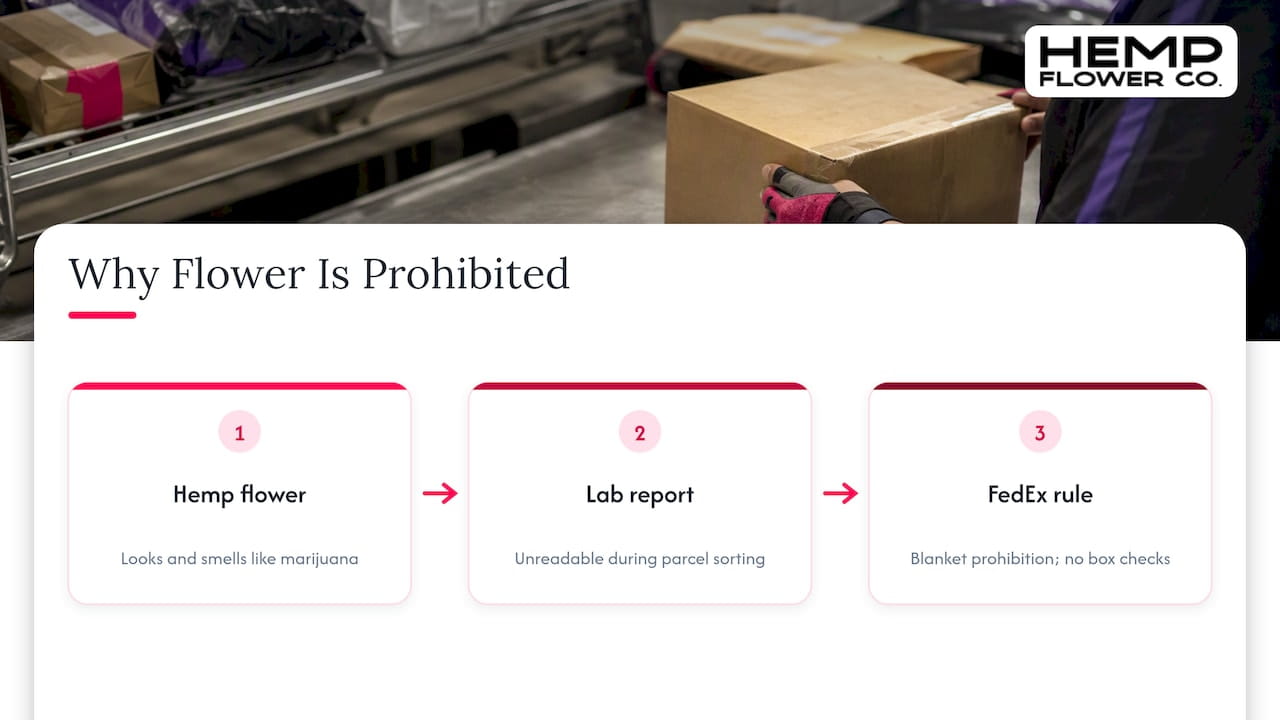
Flower is the hardest form for a carrier to judge. A bag of THCA flower and a bag of marijuana look and smell the same. The paperwork that separates them is a lab report, and a driver or a sorting facility cannot read one. FedEx therefore applies a blanket rule rather than checking each box.
Allowed, prohibited and risky: product by product
The table below summarizes what the sources support for each product type when sent with FedEx. It is a reading of the rules, not a guarantee. Always check the current FedEx Service Guide.
| Product | FedEx position | Why |
|---|---|---|
| Marijuana and marijuana-derived CBD | Prohibited | Federal definition of marijuana |
| Hemp-derived CBD, 0.3% THC or less | Described as permitted | Falls within the hemp definition |
| Raw or unrefined hemp plants and parts | Prohibited | Excluded except under 21 CFR 1308.35 |
| Hemp flower, including THCA flower | Treat as prohibited | Raw plant material, and THC content |
| Delta-8 and other intoxicating hemp products | Treat as prohibited | Prohibition on THC products |
| Anything over 0.3% THC | Prohibited | Outside the hemp definition |
Two cautions apply. First, a label that says “CBD” does not make a package a CBD shipment if the contents are flower. Second, the policy wording can change, and carrier staff interpret it. Third-party descriptions of FedEx’s position are not FedEx’s own words, so confirm with your account representative before you rely on any of this for a business.
Does the policy differ for individuals and businesses?
It does in one respect. Business accounts have contracts. Consumers dropping a box at a counter do not.
FedEx’s alcohol program is the model. To ship alcohol through the FedEx network, a shipper must be approved by FedEx, sign an agreement and follow the program rules. No equivalent hemp flower program was found in the sources used for this article. That means a business has no published route to a hemp flower contract, and an individual has none either.
A fulfillment company that works with CBD merchants says FedEx points to its Service Guide for prohibited-item terms. It recommends confirming account terms with a FedEx representative. If you are a business and your products are CBD only, get the answer in writing before you ship.
FedEx also prohibits shipments that require the carrier to obtain a local, state or federal license to transport them, as stated in the prohibited-items terms. Many regulated hemp products fall under that wording in some states. This is another reason a business contract does not open the door by itself.
What happens if FedEx finds a prohibited package
The consequences are mostly contractual, and they fall on the shipper.
- No liability for the parcel. FedEx is not liable for delay, loss or damage to a prohibited item, according to its prohibited-items terms.
- Indemnity. The same terms say the shipper agrees to indemnify FedEx for costs, fees and expenses that result from legal violations or from tendering a prohibited item.
- Account risk. A business that tenders prohibited goods can lose its account. That is a practical risk, not a quoted rule, so treat it as a risk to plan for.
- Legal exposure. Marijuana is still federally illegal. A parcel that turns out to be marijuana rather than compliant hemp can bring criminal exposure for the sender. Documentation is what separates the two.
For a buyer, the usual result is a package that never arrives, with no refund from the carrier. That is why it matters which carrier your seller uses before you order.
How compliant hemp does ship: USPS and UPS
FedEx’s refusal does not mean hemp cannot move. The other two major carriers have written rules.
USPS
USPS permits mailing hemp and hemp-based products, including CBD, with THC at or below 0.3%. The mailer must comply with applicable laws and keep compliance records for at least two years. USPS does not require documentation at the time of mailing, but it may ask for it later if the legal status or mailability of an item is in question. In practice that means a lab report and, where it applies, a license, kept on file for every batch.
UPS
UPS takes a different approach from FedEx. It allows the transportation of raw hemp for pre-approved shippers under a contractual service, provided specific documentation and safety requirements are met. A shipper without that approval cannot use it.
Vapes are a separate problem
Hemp and CBD vapes face a different barrier. A compliance summary of 2026 carrier rules says the PACT Act ban on vaping products covers hemp and CBD vapes and hardware. Check this before ordering any vape, whatever the carrier.
Paperwork that supports a legal hemp shipment
What documents should travel with a legal hemp parcel? The sources give examples rather than one national rule.
- A certificate of analysis (COA). A third-party lab report showing THC content. Montana’s state hemp plan, for example, says intrastate raw hemp transport should include a copy of the producer’s hemp license, and raw hemp with flowers should also include an official lab report showing compliance.
- A producer license. Where the state requires one, it should be on file for every batch.
- Retained records. USPS asks for two years of records, as above.
- Destination-state checks. State rules on intoxicating hemp differ and keep changing. Our guides on whether THCa flower is legal and on shipping THCA and its state risks go through them.
Buyers can also check a lab report themselves. Our checklist on verifying hemp lab reports lists six things to look at.
The November 12, 2026 change
This is the part that will matter most to hemp flower buyers over the next year. In November 2025, P.L. 119-37 amended the federal definition of hemp. The limit moved to a total THC concentration below 0.3% on a dry weight basis rather than delta-9 THC alone. The new definition also excludes final hemp-derived cannabinoid products with more than 0.4 milligrams of THC per container.
The Congressional Research Service notes that the new definition takes effect on November 12, 2026. For anyone shipping, the effect is larger than for FedEx alone. A product that is hemp today because of its delta-9 content may fall outside the definition afterward. That affects every carrier, and every seller, not only FedEx.
What to do with that:
- Read the total THC figure on the COA, not only delta-9.
- Do not assume a carrier’s current acceptance will survive the change.
- Check the seller’s current compliance statement before each order.
For background on how THCA is treated, see our explainers on THCA versus delta-9 THC and the difference between hemp and THCA hemp.
Our perspective
We sell THCA and CBD flower, concentrates, vapes and pre-rolls, and we sell to businesses as well as individuals. The carrier question comes up often, and our view is plain.
A hemp seller should not hide behind a carrier’s silence. If a carrier’s published rules prohibit a product, the seller should not tender it. A buyer should ask who delivers the order and what the seller’s lab testing shows. Both answers should be easy to get.
We test our products and publish our sourcing. A lab report is the one document that lets anyone, including a regulator, tell hemp from marijuana. For that reason we treat the COA as part of the product. It is not an add-on.
We also expect the rules to tighten. The federal definition changes on November 12, 2026, and states keep adding their own limits. Buyers should order what they need for the near term and check their state’s current rules before each purchase. Our state-by-state guide to hemp flower is the place to start. Our note on hemp shipping times explains what slows an order down.
— Michael
Buying hemp that arrives
If you are choosing a seller, the carrier is only one of the checks. A seller should name its shipping method, publish lab results and ship only to places where the product is legal. Hemp Flower Co. ships across the U.S. and publishes lab testing and sourcing information.
Current published prices include:
- Indoor THCA flower: $39.99
- Greenhouse THCA flower: $34.99
- THCA budder wax, 5 gram: $59.99
- THCa vape cartridge, 1ml: $25.99
- CBD pre-rolls, 1 gram: $10.99
Browse THCA flower and the full range, the concentrates, or the pre-rolls. Businesses can ask about wholesale THCA flower and CBD flower wholesale. Wholesale prices are not published. Resellers should also read our guide to the hemp resale license.

What to do before you ship or order
- Identify the product type: CBD, THCA, delta-8 or raw flower.
- Read the carrier’s current prohibited-items list, not a summary of it.
- Keep the COA and any license for each batch.
- Check the destination state’s rules.
- Choose a carrier whose written policy covers your product.
- Re-check after November 12, 2026.
This is general information, not legal advice. If you ship hemp commercially, ask a lawyer who works on cannabis and hemp compliance to review your process. If you are a buyer in a state with strict rules, check with your state agriculture or health department.
FAQ
Can I ship hemp flower with FedEx?
No. Raw or unrefined hemp plants and parts are prohibited, and FedEx also bars THC products. The only exception described is a narrow one under 21 CFR 1308.35. Treat hemp flower, including THCA flower, as not shippable by FedEx.
Can FedEx ship CBD?
Hemp-derived CBD products with no more than 0.3% THC are described as permitted. Marijuana-derived CBD is not. Confirm your account terms with FedEx in writing, because staff interpretation and wording can change.
What happens if FedEx finds cannabis in a package?
FedEx is not liable for delay, loss or damage to a prohibited item. The shipper also agrees to cover FedEx’s costs, fees and expenses from the violation. Marijuana remains federally illegal, so the sender can face legal exposure beyond the carrier.
Which carrier can ship hemp instead?
USPS allows hemp and CBD at or below 0.3% THC if the mailer follows the law and keeps compliance records for at least two years. UPS offers a contractual service for pre-approved shippers of raw hemp. Neither is open to every product, and vapes face a separate federal restriction.
Sources
- Guide for Shipping Hemp and Hemp-Derived CBD Products
- DEA Diversion Control Division, Controlled Substances Q&A
- Prohibited Items terms
- CBD Shipping Policy, eCommerce Fulfillment
- USPS Postal Bulletin, 2019
- UPS: Shipping Marijuana, Hemp
- Montana State Hemp Plan
- Congressional Research Service: Change to Federal Definition of Hemp
- Can You Ship Hemp, CBD & THC? Carrier Rules 2026


