


Wholesale THCA Legality in the U.S.: What Buyers Need to Know
Wholesale THCA is legal only where the product meets the federal hemp definition and the rules of the destination state. Starting December 11, 2026, that definition counts THCA toward total THC, so every wholesale lot will be judged on its total THC, its paperwork and the state it ships to. This guide covers what changed, how states license wholesalers, what shipping allows and what a buyer should check before placing a bulk order.
2026 federal hemp update: Congress changed the federal definition of hemp (P.L. 119-37, Sec. 781). The 2018 Farm Bill measured hemp by delta-9 THC alone. Starting December 11, 2026, the definition counts total THC, including THCA, at 0.3% or less, and final hemp-derived cannabinoid products are limited to 0.4 mg of total THC per container. (P.L. 119-103 delayed most of these changes from November 12 to December 11; the exclusion of cannabinoids the plant cannot naturally produce took effect November 12, 2026.) State laws differ and change often, so check your state's current rules before you buy. Source: Congressional Research Service, IF13136.
TL;DR
- Starting December 11, 2026, the federal hemp definition uses total THC, including THCA, with a limit of 0.3% on a dry-weight basis.
- Final products are also capped at 0.4 mg of total THC per container, and certain intermediates and synthesized cannabinoids are excluded from hemp.
- States add their own layers: wholesale licenses, COA rules, shipping bans. THCA is banned or restricted in a long list of them.
- Carriers do not enforce state law, but the shipper must follow the destination state’s rules.
- A wholesale buyer needs a current full-panel COA with total THC, a licensed supplier and a destination-state check for each order.
Table of Contents
- What changes on December 11, 2026
- How THC is measured
- Federal rules are the floor, states set the terms
- Shipping wholesale THCA across state lines
- A wholesale buyer’s compliance checklist
- Our perspective
- Sourcing wholesale THCA from Hemp Flower Co.
- FAQ
- Sources
What changes on December 11, 2026
For years, THCA flower was sold under the 2018 Farm Bill wording. That wording defined hemp by its delta-9 THC concentration of no more than 0.3% on a dry-weight basis. THCA is the raw, non-intoxicating acid form that converts to delta-9 THC when heated, and the old wording did not count it.
Congress amended the definition in P.L. 119-37, enacted November 12, 2025, with the change originally set to take effect 365 days later, on November 12, 2026. P.L. 119-103 then delayed most of it to December 11, 2026. From December 11, 2026, the statute measures total tetrahydrocannabinols, THCA included, at no more than 0.3% on a dry-weight basis. The same page shows the amended text.
The Congressional Research Service summarizes the new exclusions. Once the new definition applies, these are not hemp and fall under the Controlled Substances Act as marijuana (the exclusion for cannabinoids the plant cannot naturally produce has applied since November 12, 2026; the rest applies from December 11, 2026):
- viable seeds above 0.3% total THC
- cannabinoids that are not naturally produced by the plant
- cannabinoids synthesized outside the plant
- intermediate products above 0.3% combined
- final products above 0.4 mg per container
The statute defines a container for the 0.4 mg cap as the innermost packaging in direct contact with the retail product: a jar, bottle, bag, box, packet, can, carton or cartridge. Bulk shipping containers are not counted, per the full Section 781 text reproduced here.
For a wholesale buyer, the practical result is simple. The old argument that THCA flower is legal because it contains little delta-9 no longer carries the weight it did. The question now is total THC on the certificate of analysis (COA), the lab report for a specific batch.
How THC is measured
Total THC is not a guess from the label. It is a calculation from lab results. The USDA’s hemp program uses the formula THCA multiplied by 0.877, plus delta-9 THC, reported on a dry-weight basis. Dry weight means the sample is measured without its water content, which is why a number on a wet product cannot be compared with a dry-weight limit.
For USDA-licensed producers, 7 CFR 990.25 requires testing that accounts for decarboxylation, which is the conversion of THCA to THC by heat. The lab must report total THC with its measurement of uncertainty, and since December 31, 2022 licensees may only use laboratories registered with the DEA.
Two details matter when you read a COA:
- Total THC, not just delta-9. A report that lists only delta-9 THC no longer answers the legal question.
- Batch and date. A COA is tied to a batch. A report that does not match the lot you receive does not document that lot.
Federal rules are the floor, states set the terms
Hemp is no longer a Schedule I controlled substance under federal law, but the Congressional Research Service notes that states have amended their own laws to prohibit products that may be hemp federally. Virginia’s total-THC limit is one example. Wholesale legality is therefore a state-by-state question, and three states show the range.
Texas
Texas adopted Chapter 300 amendments that count THCA in its total delta-9 THC and acceptable-hemp-THC definitions. The adopted rules set manufacturer fees at $10,000 per facility and retailer registration fees at $5,000 per location. Distributors must hold a wholesaler license under Health and Safety Code Chapter 431.
Georgia
Georgia requires a $500 annual wholesale consumable hemp license for each facility. Flowers and leaves are unlawful to offer for retail sale there regardless of THC concentration, and products need a public full-panel COA from the last 12 months.
The state’s rule 40-32-4-.02 ties the license to a single location and requires owner names, a Certificate of Existence and consent to inspections. It prohibits wholesaling products without a current full-panel COA, without the universal THC warning sticker, above the legal total delta-9 limit or in non-compliant containers.
Tennessee
Tennessee’s Public Chapter 526 took effect January 1, 2026. According to HempData’s state guide, it makes it unlawful to ship a hemp-derived cannabinoid product directly to a Tennessee consumer, and these products must move through licensed suppliers, wholesalers and retailers. Batch-linked COAs and QR-code testing disclosure apply.
The pattern is consistent: license the wholesaler, document each batch, control the label and limit how product reaches the consumer. A buyer who resells has to meet those rules in the state where the product is sold, not only where it was packed.
Shipping wholesale THCA across state lines
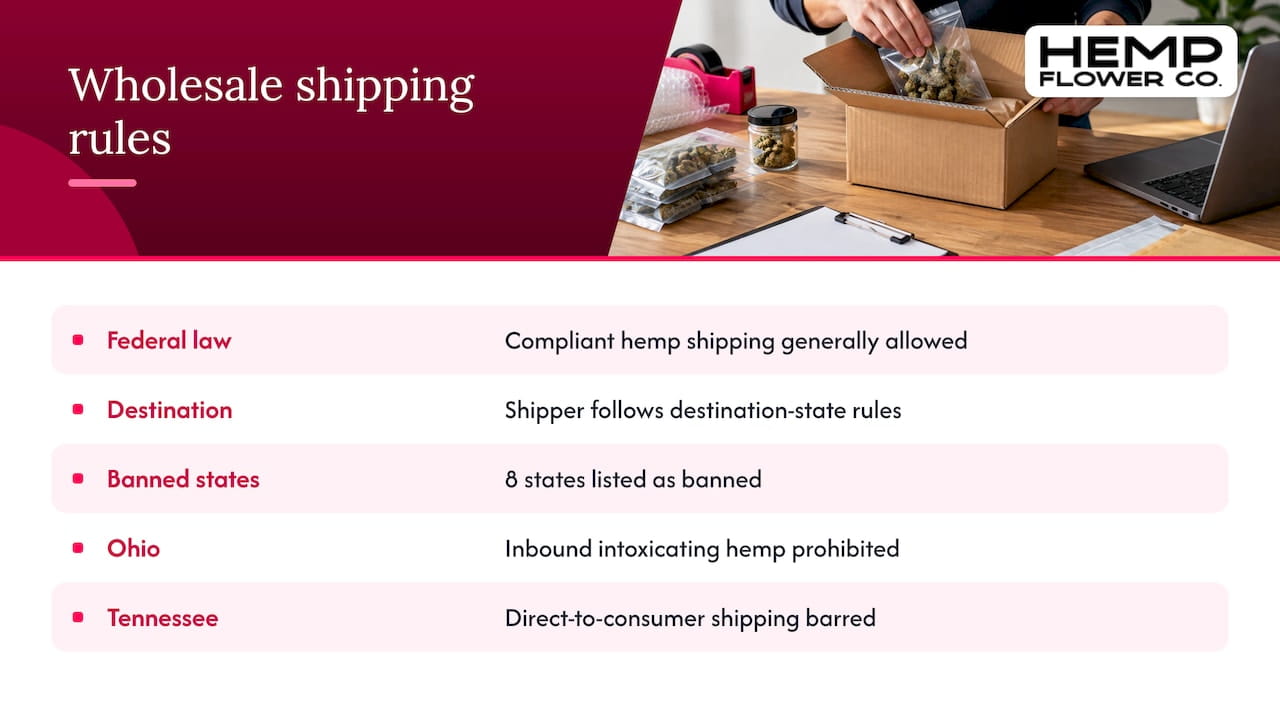
Federal law does not generally prohibit shipping compliant hemp through common carriers such as USPS, UPS and FedEx, and carriers are not required to enforce state restrictions. That is the finding of the ATACH 2026 Hemp Intoxicants Report. The same report is clear that the shipper must follow the destination state’s rules.
That means THCA cannot go to all 50 states. As of May 1, 2026, the report lists THCA as banned in Alaska, Arkansas, Idaho, Kansas, Mississippi, North Dakota, Rhode Island and South Dakota, and restricted in many others. Ohio SB 56, effective March 20, 2026, prohibits inbound shipping of intoxicating hemp, and Tennessee bars direct-to-consumer shipping of hemp-derived cannabinoid products. The report also notes that bulk intermediates above 0.3% total THC cannot move interstate under Section 781.
State lists change often, so confirm the destination before every order. Our own guides on shipping THCA and the state risks and on what FedEx allows for hemp walk through the carrier side in more detail.
A wholesale buyer’s compliance checklist
Use this list for each order, whatever the product.
- Confirm the destination state. Check whether THCA is banned, restricted or licensed there, and whether your own license covers the sale. Georgia, Texas and Tennessee each add wholesaler licensing or distribution rules.
- Match the COA to the lot. The report should be current, tied to the batch and a full panel. Georgia, for example, requires one from within the last 12 months.
- Read the total THC line. It should include THCA, be reported on a dry-weight basis and carry a measurement of uncertainty. Federal part 990 treats the acceptable level as an uncertainty range that includes 0.3% or less.
- Check the lab. DEA registration is the standard for USDA licensees. Ask which lab produced the report.
- Understand how each ingredient is made. Law firm Vicente LLP advises operators to look at how each ingredient is produced, not only whether the cannabinoid occurs in the plant, and to keep supplier documentation of extraction and manufacturing alongside COAs reporting total THC. This matters most for concentrates, vapes and edibles.
- Check packaging and labels. Per-container limits apply to the innermost retail package, and some states require warning stickers and specific containers.
- Keep your records. Keep COAs, invoices and shipping documents together. USPS also expects mailers of hemp to retain lab results.
- Verify age and license on the buyer side. Retail sales are limited to adults 21 or older under the terms Hemp Flower Co. applies to its orders.
Our perspective
Wholesale buyers ask us one question more than any other: can they put THCA on the shelf and keep it there. The answer depends on paperwork and on the state, and we build our wholesale program around that.
At Hemp Flower Co., we test our products in the lab and we publish where they come from. We offer wholesale THCA flower and CBD flower lots for businesses and dispensaries, so a buyer can compare strains, grades and sizes in one place, from indoor flower to greenhouse smalls and trim.
Our view is that a good supplier makes compliance easier to document, not harder. Lab-tested lots, clear sourcing and a COA a buyer can read are the basics, and the new total-THC definition makes them more important, not less. We keep our shipping guidance current for the same reason.
If you resell, read your state rules first and match each lot to its report. That habit protects your license and your customers.
Michael
Sourcing wholesale THCA from Hemp Flower Co.
Hemp Flower Co. sells wholesale THCA flower and CBD flower to businesses and dispensaries, with lab testing and transparent sourcing. Wholesale lots include the DEA-4 indoor THCA flower, Face Gas THCA smalls and DEA-4 greenhouse THCA trim. CBD buyers can look at Hempress CBD flower wholesale and Bubba Kush CBD wholesale. Wholesale pricing is not published, so request it through the product page.

For retail buyers, the main store lists indoor THCA flower at $39.99 and greenhouse THCA flower at $34.99. The concentrates collection includes THCA Budder Wax and THCA Crumble Wax at 5 grams for $59.99 each, and the vape collection lists the THCa Vape Cartridge 1ml at $25.99. Shipping is nationwide where state law allows it.
THCA Black Friday Sale 2026
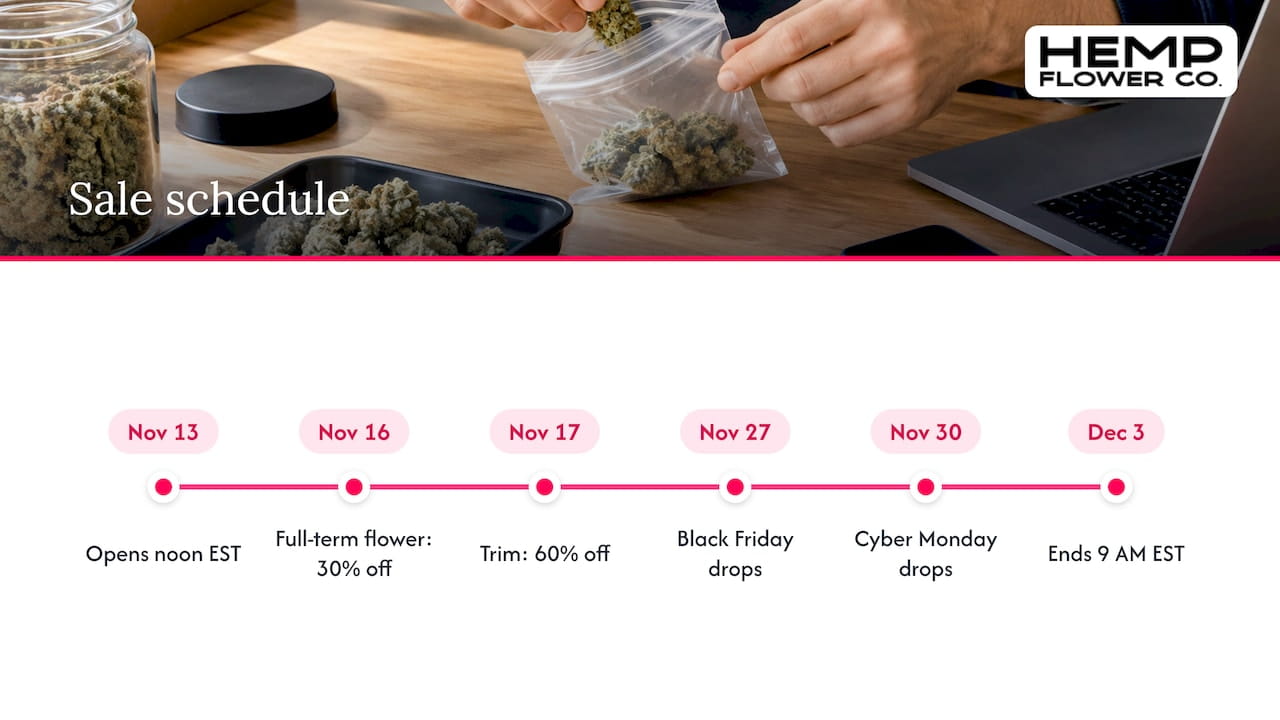
Hemp Flower Co.'s THCA Black Friday sale runs from noon EST on November 13, 2026 to 9 AM EST on December 3, with 30 to 40% off select flower, smalls, pre-rolls, concentrates, vapes and edibles. Each product page shows its own discount.
Featured drops include 30% off full-term THCA flower on November 16 and 60% off THCA and CBD trim on November 17. More drops are planned for Black Friday (November 27) and Cyber Monday (November 30), and wholesale has separate deals. The sale covers THCA flower tiers, budget smalls, trim and kief, concentrates, vapes and gummies, plus CBD and Delta 8 lines.
No promo codes are listed, and coupons usually won’t stack with sale prices. Buyers must be 21 or older, some states cannot receive shipments, and popular items may have limits or sell out.
FAQ
Is THCA still legal in the United States?
THCA is not listed as its own controlled substance, but starting December 11, 2026 it counts toward the total THC limit of 0.3% that defines hemp. Material above that limit is treated as marijuana under federal law. States add their own bans and licensing rules, so legality depends on the state as well.
Can THCA be shipped to all 50 states?
No. Federal law does not generally stop compliant hemp from moving through common carriers, but the shipper must follow the destination state’s rules. THCA is banned in several states and restricted in many more, and some states bar direct-to-consumer shipping altogether.
Can you legally sell THCA wholesale?
In many states, yes, with the right license and paperwork. Georgia requires a $500 annual wholesale license per facility, Texas requires a wholesaler license under Chapter 431, and Tennessee routes products through licensed suppliers and wholesalers. Federal law adds the total THC limit and the per-container cap.
What should a wholesale COA show?
A useful COA is a current full-panel report tied to the batch. It reports total THC including THCA on a dry-weight basis with measurement of uncertainty, from a DEA-registered laboratory. Some states, such as Georgia and Tennessee, add specific COA and labeling requirements.
Sources
- 7 U.S.C. § 1639o: Definitions
- USDA AMS Hemp FAQ
- CRS R48637: The 2018 Farm Bill’s Hemp Definition and Legal Challenges
- CRS IF13136: Changes to the Statutory Definition of Hemp
- 7 CFR 990.25: Standards of performance
- Georgia Department of Agriculture: Wholesale Consumable Hemp Licenses
- Georgia Rules and Regulations 40-32-4: Hemp Product Manufacturers
- Texas Register: Adopted Rules Title 25, March 2026
- HempData: Is Hemp Legal in Tennessee?
- ATACH Hemp Intoxicants Report 2026
- Delta-8 THC: Federal Status (2026)
- Vicente LLP: Federal Hemp Definition Change
Recommended
- Shipping THCA Before Nov 12, 2026: State Risks & Compliance Checklist
- California Thca Flower Wholesale Market Explained
- Is THCa Legal? - THCa Legality in the United States
- Wholesale THCA Distributors: How to Choose the Right Supplier
Shop Lab-Tested Hemp at Hemp Flower Co.
Ready to compare options? Shop our indoor THCa flower and THCa pre-rolls. Every product page includes the lab COA so you can check potency before you buy.
Retailers comparing suppliers can also request bulk pricing from our sister farm, Oregon Hemp Flower. Looking for a CBD-forward option? Ideal Plus, our sister brand, makes CBD pre-rolls and CBD wax.
Related guides:


