


Is THCA Kief Legal in 2026? Farm Bill Compliance Explained
THCA kief is one of the most potent, sought-after hemp concentrates on the market right now — and also one of the most misunderstood from a legal standpoint. If you've been searching for a straight answer about is THCA kief legal, you're not alone. Questions about THCA kief legality consistently rank among the most searched topics in the hemp space, and the confusion is completely understandable. The law is genuinely layered, the regulatory environment has shifted multiple times since 2018, and state-by-state rules add another layer of complexity that no single headline can capture.
This guide cuts through the noise. We'll walk through exactly where THCA kief Farm Bill compliance stands in 2026, how federal law defines legal hemp, where states are drawing their own lines, what a new Farm Bill could mean for consumers and retailers, and how to verify that any THCA kief you're buying is actually compliant. Whether you're a longtime hemp consumer or someone just getting acquainted with hemp-derived THCA kief, this is the breakdown you need.
The Foundation: What the 2018 Farm Bill Actually Says
Every conversation about hemp kief legal 2026 status has to start here. The Agriculture Improvement Act of 2018 — universally known as the 2018 Farm Bill — is the federal legislation that changed everything for the hemp industry. Before it passed, hemp was treated the same as marijuana under federal law: a Schedule I controlled substance with no legal commercial pathway.
The 2018 Farm Bill changed that by creating a federal definition of hemp that separated it legally from marijuana. Under that definition, hemp is Cannabis sativa L. and any part of that plant — including seeds, derivatives, extracts, cannabinoids, isomers, acids, salts, and salts of isomers — with a Delta-9 THC concentration of no more than 0.3% on a dry weight basis.
Read that definition carefully, because the specific language matters enormously when we're talking about federal hemp law THCA products. The law defines hemp based on Delta-9 THC — not THCA, not total THC, not any other cannabinoid. Delta-9 THC is the specific molecule that makes the cut.
That single legislative choice created the legal foundation on which the entire post-2018 THCA market has been built. THCA is tetrahydrocannabinolic acid — the raw, acidic, pre-decarboxylated precursor to Delta-9 THC that exists naturally in the live hemp plant. At the moment of harvest and testing, THCA and Delta-9 THC are chemically distinct compounds. Under a strict reading of the 2018 Farm Bill hemp definition, THCA is not Delta-9 THC — and the law, as written, only restricts Delta-9 THC.
This is not a loophole manufacturers invented. It's an artifact of how federal legislators defined hemp in 2018, and it's the framework under which licensed hemp farms, processors, retailers, and laboratories have been operating ever since.
Why THCA Kief Falls Under Federal Hemp Law
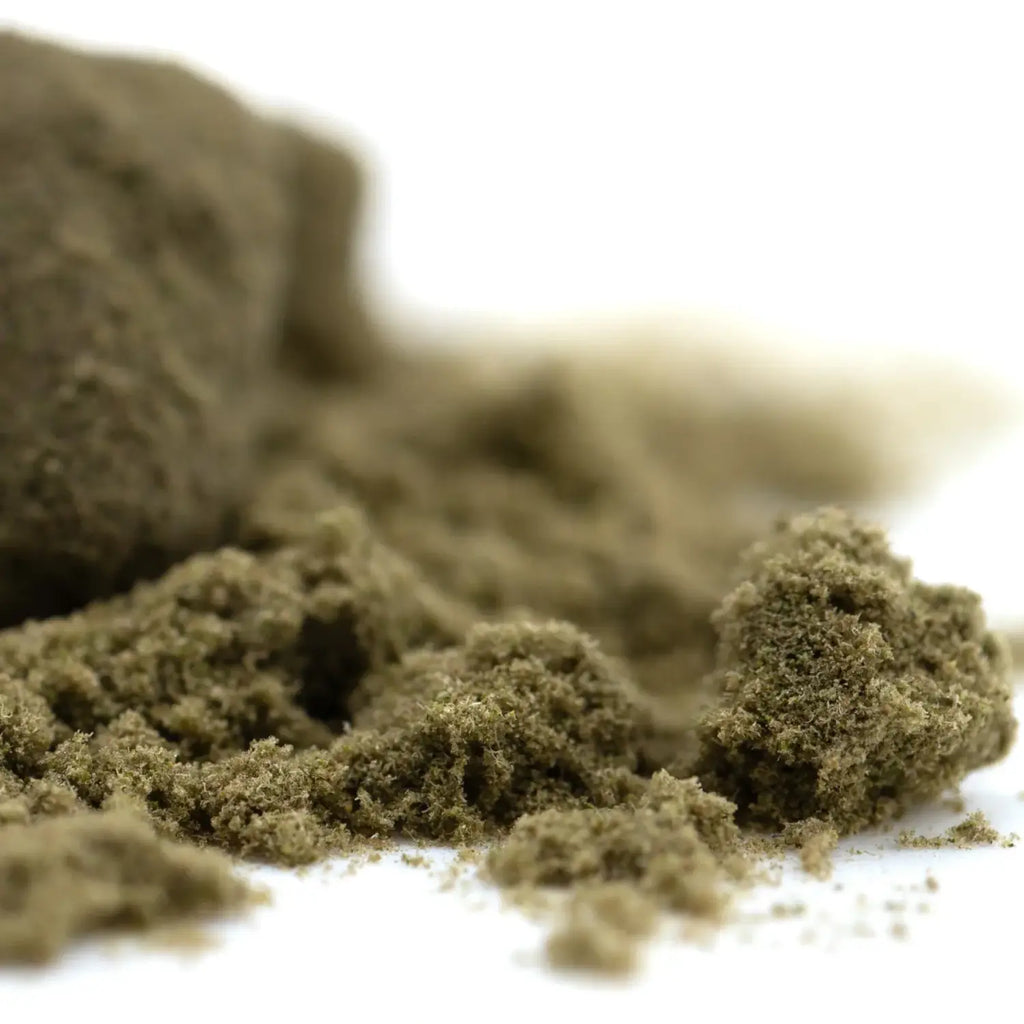
To understand THCA federal loophole status, it helps to understand what kief actually is and where it comes from. Kief is the collection of trichomes — the resinous, crystal-like glands that coat the surface of hemp flower — that have been mechanically separated from the plant material. No solvents, no chemical extraction. It's a pure, concentrated product of the hemp plant itself.
Because hemp plants naturally produce THCA as the dominant cannabinoid before decarboxylation occurs, high-THCA hemp flower produces high-THCA kief. Modern hemp breeders have developed strains that produce substantial THCA concentrations — often 15% to 30% or higher in the raw flower — while maintaining Delta-9 THC levels at or below the 0.3% federal threshold.
When kief is mechanically sifted from these federally compliant hemp plants, the resulting concentrate inherits the same compliance status as the source material. The Delta-9 THC content remains below 0.3% because the THCA hasn't been converted to Delta-9 through heat. As a standalone compound in its acid form, THCA is not scheduled under the Controlled Substances Act, and it does not fall within the federal definition of marijuana or the Delta-9 THC concentration limits set by the Farm Bill.
This is why hemp-derived THCA kief from reputable suppliers comes with a Certificate of Analysis — commonly called a COA — showing Delta-9 THC at or below 0.3%. That lab result is the document that establishes federal compliance. A properly formatted COA from a DEA-registered third-party lab will typically show:
- Delta-9 THC: ≤ 0.3% dry weight (federal compliance threshold)
- THCA: Listed separately, often significantly higher
- Total cannabinoid profile: Includes all detected cannabinoids individually
- Total THC: Sometimes calculated and listed, which we'll address in the next section
As of 2026, this framework remains the operating standard for is THCA kief legal to buy from licensed hemp retailers in the commercial marketplace. The DEA has challenged this interpretation, and certain state regulators have rejected it entirely, but at the federal level the commercial hemp industry has continued operating under the Delta-9-only compliance standard.
The Total THC Rule: The Biggest Source of Legal Ambiguity
Here's where THCA 0.3% rule discussions get genuinely complicated — and where honest retailers need to be transparent with consumers.
The USDA, in its hemp cultivation regulations, applies a "total THC" calculation when determining whether a hemp crop passes pre-harvest testing. This formula converts THCA's potential into equivalent Delta-9 THC using the following calculation:
Total THC = (THCA × 0.877) + Delta-9 THC
The 0.877 figure is a decarboxylation conversion factor — it represents how much Delta-9 THC would theoretically be produced if all the THCA in a sample were fully converted through heating. Under the USDA's total THC standard, hemp crops that test above 0.3% total THC are "hot" and must be destroyed rather than harvested.
This total THC framework, if applied to retail hemp products, would effectively make nearly all high-THCA flower and concentrates — including kief with 20%+ THCA — illegal, since those products would obviously exceed 0.3% when THCA conversion is factored in.
The critical distinction is that the USDA's total THC rule currently applies to hemp cultivation and pre-harvest crop testing — not to finished retail products. The Farm Bill's 0.3% limit refers to the plant at harvest, and the DEA and FDA have not formally extended total THC calculations to finished hemp consumer products in a way that has comprehensively eliminated the retail THCA market.
That said, this remains the single most contested area of THCA legal status 2026. The DEA has at various points issued guidance suggesting that hemp-derived THCA could be considered a controlled substance if its total THC potential exceeds 0.3%. Legal challenges have gone back and forth in federal courts. The bottom line for consumers: the total THC calculation creates a genuine area of legal ambiguity that should not be dismissed, and regulatory clarification — or restriction — remains possible.
State-by-State THCA Laws in 2026: Where It Gets Complicated
Federal law provides the floor, but states have enormous authority to regulate hemp products within their borders — and many have exercised that authority aggressively when it comes to high-potency hemp products. State THCA laws 2026 vary dramatically, and your state's position matters as much as federal law when it comes to what you can legally purchase and possess.
States That Have Restricted or Banned High-THCA Products
A growing number of states have moved to close what their legislators view as the "THCA loophole" in various ways:
States applying total THC calculations at the state level have effectively banned high-THCA hemp flower and concentrates by defining hemp to include the THCA conversion formula. Under this approach, THCA kief with 20% THCA would be classified as marijuana regardless of its Delta-9 THC content.
States with explicit THCA bans or restrictions have passed legislation or adopted regulatory rules that specifically call out THCA as a controlled substance or require THCA products above certain thresholds to be sold only through licensed cannabis dispensary channels — an option unavailable in states without medical or adult-use cannabis programs.
States with hemp product potency caps have attempted to limit the THCA or total THC concentration allowed in retail hemp products, setting thresholds that would exclude most commercial THCA concentrates including kief.
Specific states that have enacted notable restrictions on THCA hemp products include (but are not limited to) Arkansas, Hawaii, Idaho, Minnesota, Oregon, and others — and this list continues to evolve as state legislatures and regulatory agencies update their rules.
States with Permissive THCA Frameworks
Many states — particularly those in the Southeast, Midwest, and parts of the South — have largely allowed the commercial hemp market, including THCA products, to operate under federal compliance standards without significant additional restrictions. In these states, is THCA kief legal to buy generally gets a yes answer, provided the product comes with compliant lab testing showing Delta-9 THC at or below 0.3%.
Why You Must Verify Your State Independently
The state regulatory landscape changes frequently — sometimes with very little public notice. A state that permitted THCA products in 2024 may have enacted restrictions by 2026, and vice versa. Before purchasing any hemp kief legal 2026 product, you should independently verify the current legal status in your specific state using:
- Your state's department of agriculture website
- Your state's controlled substances scheduling list
- Reputable hemp industry news sources that track legislative changes
Do not rely solely on a retailer's representations about your state's laws. Reputable retailers will be upfront about states they don't ship to, but ultimately it's the consumer's responsibility to understand local law.
How a New Farm Bill Could Reshape THCA Kief Legality
The 2018 Farm Bill was written to expire and be reauthorized every five years. That reauthorization process has been significantly delayed, with Congress continuing to extend the existing Farm Bill on a temporary basis while negotiations over a new version have dragged on. As of 2026, THCA kief Farm Bill uncertainty tied to this legislative process remains real.
The Restrictive Scenario
Some versions of proposed Farm Bill language have included provisions that would apply total THC calculations to hemp products across the board — not just at the crop level. If this language becomes law, it would fundamentally change the legal status of high-THCA hemp products, potentially eliminating the commercial THCA market as it currently exists or requiring it to migrate entirely to state-licensed cannabis channels.
Draft language in certain proposed versions has also included specific THCA concentration limits for hemp products, minimum age requirements for purchase, and explicit bans on intoxicating hemp-derived products — language that would clearly capture THCA kief given its potency.
The Protective Scenario
Hemp industry trade associations and advocacy groups have pushed hard for explicit statutory protections for THCA products in any new Farm Bill. Their argument is that THCA, in its undecarboxylated form, is a naturally occurring hemp cannabinoid that should be protected under the same framework as CBD and other hemp compounds.
Proposed language in industry-supported versions would explicitly define THCA as a hemp-permissible cannabinoid, establish clear compliance standards for THCA products that don't rely solely on total THC conversion calculations, and provide a stable regulatory home for the existing market.
The Devolution Scenario
A third possibility gaining traction in some policy discussions is federal legislation that largely defers hemp product regulation to states — essentially getting the federal government out of the business of setting detailed product standards and leaving states to manage their own markets. Under this framework, hemp kief legal 2026 status would become entirely a state-by-state question, creating a patchwork that mirrors the current adult-use cannabis landscape.
The Practical Takeaway
As of 2026, no new Farm Bill has been enacted, and the existing framework — however contested — remains operative. But this is not a stable long-term situation. Anyone purchasing, retailing, or producing THCA kief should stay actively informed about Farm Bill developments through sources like the Hemp Industries Association, Leafly's policy coverage, and Hemp Today.
Reading a THCA Kief COA: What Hemp Compliance Actually Looks Like
The COA is the single most important document in the hemp compliance COA conversation. Every reputable THCA kief supplier should provide batch-specific, third-party lab testing that you can access and verify before purchasing. Here's how to read it intelligently.
What to Look For
Accredited lab credentials: The testing facility should be ISO 17025-accredited and, for hemp products crossing state lines, the lab should ideally be DEA-registered. Look for the lab's name, address, and accreditation number on the COA.
Batch-specific testing: Generic product-level COAs that aren't tied to a specific production batch are meaningless from a compliance standpoint. Look for a batch or lot number that matches what's on the product packaging.
Delta-9 THC result: This is the federal compliance number. It must show ≤ 0.3% on a dry weight basis. Any result above this threshold means the product is not federally compliant.
THCA result: This will typically be much higher than the Delta-9 THC reading — often 15% to 40% or higher for potent kief. This number tells you the product's potency and is listed as a separate cannabinoid from Delta-9 THC.
Testing date: COAs should be recent. Testing results that are more than 12 months old may not accurately reflect the current product, especially if storage conditions have changed cannabinoid profiles over time.
Pesticide and residual solvent panels: Particularly for kief, which concentrates everything from the plant including potential contaminants, look for a COA that includes pesticide residue testing and confirms the product is free from harmful agricultural chemicals.
What to Avoid
Suppliers who won't provide COAs. Full stop. No COA means no compliance verification, and there's no legitimate reason for a hemp retailer to withhold this documentation.
COAs that show only Delta-9 THC without listing other cannabinoids. A panel that conveniently omits THCA entirely may be obscuring relevant information.
Suspiciously round numbers. Lab results should show real analytical precision, not perfectly round figures that suggest the testing wasn't conducted rigorously.
QR codes that don't resolve or lead to generic product pages. Many reputable suppliers embed QR codes on their packaging linking directly to the batch-specific COA. Test those codes before you trust them.
Frequently Asked Questions About THCA Kief Legality
Is THCA kief legal to buy online in 2026?
At the federal level, is THCA kief legal to buy online is generally a yes, provided the product comes from a licensed hemp processor and carries a compliant COA showing Delta-9 THC at or below 0.3%. However, shipping THCA kief to states that have enacted their own restrictions or bans on high-THCA hemp products may violate state law. Reputable suppliers maintain updated lists of states they cannot ship to.
Does THCA kief get you high?
This is one of the most asked questions accompanying the legal ones, and it's directly relevant to why regulators pay attention to THCA products. Yes — when THCA is heated (smoked, vaped, or otherwise decarboxylated), it converts to Delta-9 THC and produces psychoactive effects. The potency of THCA kief, which concentrates the trichomes from hemp flower, means these effects can be significant. This is precisely why some states have moved to restrict THCA products despite their technical federal compliance.
What does THCA kief look like on a drug test?
Consuming THCA kief will very likely cause a positive result on a standard drug test. Drug tests screen for THC metabolites, and when THCA converts to Delta-9 THC through decarboxylation, those same metabolites are produced. The legal status of the product has no bearing on drug test results.
How is THCA kief different from marijuana concentrate?
From a chemical standpoint, the difference is the source plant's genetics and compliance testing. THCA kief derived from federally compliant hemp plants with Delta-9 THC at or below 0.3% is categorized as a hemp product under federal law. Concentrate derived from marijuana plants — or from hemp plants that test above 0.3% Delta-9 THC — is categorized as a marijuana product. The experiential effects of high-THCA kief and marijuana concentrate can be very similar once decarboxylation occurs.
What is the THCA federal loophole exactly?
The term "loophole" refers to the fact that the 2018 Farm Bill's 0.3% threshold applies specifically to Delta-9 THC, not THCA. Since THCA and Delta-9 THC are chemically distinct compounds at the moment of testing — before heat converts one to the other — products with very high THCA concentrations can technically test within federal limits. It's called a loophole because many regulators view the psychoactive equivalence of THCA (once consumed) as making this distinction functionally meaningless, even if it's legally meaningful under current statutory language.
Will THCA kief become illegal if a new Farm Bill passes?
Possibly, but it depends entirely on the final legislative language. Some proposed versions would effectively eliminate the commercial THCA market by applying total THC calculations to retail products. Others would explicitly protect THCA. Until a new Farm Bill is signed into law, the existing framework governs. Stay informed through reliable hemp industry news sources.
Can I travel with THCA kief?
Traveling with THCA kief is significantly more complicated than purchasing it. Interstate travel — including flying — involves crossing federal jurisdiction, and TSA agents and federal law enforcement may not distinguish between hemp-derived THCA kief and marijuana concentrate on sight. Additionally, if you're traveling to a state that restricts or bans THCA products, you may be in violation of destination state law upon arrival. Traveling with any hemp-derived concentrate involves real risk that consumers should carefully consider.
Buying THCA Kief in 2026: A Smart Consumer Checklist
Before completing any THCA kief purchase, run through these verification steps:
- Verify your state's current THCA laws. Don't rely on what was true six months ago — check your state's current hemp regulations.
- Request or locate the batch-specific COA. It should be easily accessible on the retailer's website or available on request.
- Confirm Delta-9 THC is at or below 0.3%. This is the federal compliance threshold — non-negotiable.
- Review the full cannabinoid panel. THCA should be listed separately and clearly.
- Check the lab's credentials. ISO 17025 accreditation is the standard.
- Look for pesticide testing results. Kief concentrates plant material, including any pesticide residues present in the source flower.
- Evaluate the supplier's transparency. Do they clearly state which states they ship to? Do they have accessible customer service? Are they able to answer basic compliance questions?
Final Thoughts
The honest answer to is THCA kief legal in 2026 is: federally, yes — under the framework established by the 2018 Farm Bill hemp definition — but with meaningful caveats. That federal compliance is based on an interpretation of the law that remains contested at regulatory levels, a new Farm Bill could shift the picture significantly, and state THCA laws 2026 create a patchwork that means legal in one state doesn't mean legal everywhere.
The right approach as a consumer is to buy from reputable suppliers who provide transparent, batch-specific lab testing; verify hemp compliance COA documentation before purchasing; know your state's current laws; and stay informed as the regulatory environment continues to evolve. THCA legal status 2026 is more stable than it was during some of the peak uncertainty of 2023 and 2024, but it is not permanently settled — and treating it as such would be a mistake.
For consumers who want access to high-quality, lab-tested, compliant hemp-derived THCA kief, the products and documentation to make an informed decision are available. Know what you're buying, know where it comes from, and know the rules in your state.


